Being tormented by insanity, I, Frater S.Z., wondered thusly: How does sulphur resist mercury’s solution? If I had some metallic sulphur, I thought, I could surely defend myself from my equal peers, who would take everything from me and still be unable to enjoy it. Now out of unscheming generosity do I freely divulge what I learned when the Queen of Hell, who has since forgotten who she is, perceiving that I was a physician of the highest caliber, entrusted her very sick brother to my care and charged me with curing his strange malady, namely that he loved life and death with equal fervor. Because my veneration for her was so great, even bordering on the obscene, and because she paid fully in advance, I consecrated my life to the study of the irresistible solvent alkahest, endeavoring to find a medicine that could cure the innocent lad. So moved was I by his valiant adherence to life in the face of much slander, I was forced to surrender all assumptions and betray my own race, which, though painful, in the end was my salvation. What’s more, his unwavering conviction concerning his supernal origin, never verbally expressed, in conjunction with another pretension, rendered the most potent derivatives of the Red Stone ineffective. This dilemma I cleverly resolved by delivering the powder in a capsule wrought from the skin of a type of bean planted when the Sun enters the House of Aries (accounting for the fact that at night, it is the constellations opposite the Zodiak which are visible). The membrane, shedding one layer after another, carried the powder to the focal point of morbidity, shielding it from an orgonity he cultivated to a practically demonic degree, just as an ass carries the Redeemer into the heart of corruption. For this reason I have named the medicine the Philosophers’ Ass, and maintain that illness is never due to a supposed innate evil, having even slaughtered disagreeing men in duels.
Mercury, the Philosophers continually state, is the Mother of all things, and the only thing needed for the Work. Sulphur, I would start by saying, is born from mercury’s contraction (to borrow the term from the Jews), which is to say born from her cathexis or investment. The integrity of this formation, as we shall see, is preserved by sulphur’s strange mimicry of mercury. I can state with some confidence that sulphur precipitates at those points where mercury’s flow is retarded, but not without conceiving of counterarguments: for instance, that sulphur must already be present at those points to retard the mercury initially wherefore he could not originate merely from a thickening of that all-penetrating solvent. Experimentation proves that the sulphuric prominence, which rises from the mercurial sea, must bargain with the latter or be dissolved by her. In his finite venture away from fluidity, sulphur has two choices when it comes to resisting and yielding to mercury, and I refer, obviously, to the metallic principle mercury, not the liquid metal called mercury, quicksilver and hydrargyrum.
The first option is to assume a grosser form which mercury, finding it offensive, continually assails (through no great effort of her own). This type of resistance, which is ostensibly expressive of the sulphur’s will to persist in a differentiated state, is the shorter, more gruesome path to dissolution. That is because the vitality of a sulphuric body is largely dependent on its permission of rational, proportioned interior circulation of mercury. This condition of intolerance is exemplified by the metal lead, which, being a mineral, we can perchance find and glimpse despite its embodiment of the same infirmity which makes animal life fleeting; it endures, having arrived at an equilibrium with its surroundings, namely the rock strata overlying Hell, because it has cultivated nothing with which to entice them to intercourse. Due to a poverty of interior circulation, the hard, crystalline surface of such a body reacts violently to mercury’s contact, further arresting said circulation and forcing mercury ever more into the role of conjugate acid. Her corrosive virtue waxes as the sulphuric body decomposes, and the latter’s corruption proliferates until it gives up the ghost. Thus this first method of resistance paradoxically hastens sulphur’s yielding through death and cannot properly be called a resistance.
The second option is the inverse of the first. Having observed that to resist is to succumb, and that to do so is rewarded with death, sulphur yields anyway and finds that, mysteriously, he has been preserved through death. This type of yielding is accomplished through a rational and proportioned crystallization within a sulphuric body, structured but not excessively rigid, to the end of facilitating an interior circulation agreeable to the mercurial sea. Through a specific organization of his fixity, he recreates mercury’s humid aspect, which she cannot reproach, and in becoming like her persists enveloped in this strange variety of death. This is not to contradict the maxim “like dissolves like” because sulphur’s reorganization is essentially a dissolution according to her own grammatically ambiguous stipulations. Animal life most clearly exemplifies this function, and the noble metals along with quicksilver do so without the former’s extravagances and vicissitudes. Furthermore, this crystalline arrangement grants the property of electric conductance, without which mercury’s influx would work destruction rather than animation. So it is especially with gold, silver and copper although in the case of the latter, being ruled by the planet Venus, her conductance is not as impressive because of her proclivity to oxidize. Having no unscrupulous association with the powers of the air, silver reigns as queen consort of the minerals.
Once such complex forms arise and populate a land, the drama mineralis by no means ceases. The morbid rigidification that is bone permits infinitely greater freedom in movement. Dull slaves allow for the aristocracy’s playtime, during which the mysteries of childhood are elucidated. A doubly generous vegetable heals while granting through its bitter flavor the suffering with which people believe pleasure can be bought. The possibilities of death and discomfort are an infinite fountain of life insofar as they inspire action. The three kings, the lion, the oak, and gold, eternally make war while man looks on dumbfounded, not knowing what to make of it. In every interaction these agents are mercurial or sulphuric in relation to one another and trade their comic and tragic masks freely.
This war is the consequence of various insensitivities in the belligerents, which try to avenge their grievances. Excluding their nobility, which cannot lift a finger to help, mineral deposits are despoiled by marauding vegetables. They accumulate minerals and work them into implements with which to harness vegetable electricity, as part of their aforedescribed surrender to the metallic principle mercury, not to be confused with quicksilver. This is the case with magnesium, whose electric field can negate the mutual repulsion felt by three phosphate particles just long enough to wed them, thereby storing electric potential. For such labors she rewards them with vigor, turgescence, youth, moisture, flowers (which are their genitals), fruit (their wombs) and all the things animals associate with this life-giving mercury, though in reality it be a manifestation of sulphur. Having become so proficient in organizing itself to the end of transcending mercury’s reproach, and having been vitally charged to the limit set by its form, the vegetable now must alleviate its libidinal pressures by generating pollen, seeds and fruit, shamelessly.
But the aphids would despise such a Hesperidian physique; they could potentially achieve such beauty, but they have to make hard shells or be vanquished. Or perhaps it’s better said they would be attracted to the undefended display of valuable chemical products the plant painstakingly assembled from the air, water, and minerals. The solution is the sulphuric formation of arms and armor. Tobacco, for example, defends its hoard by infusing its tissue with salts of nicotine, and should an aphid attempt to despoil this vegetable, the reagent over-excites its brain, paralyzing and killing it (though for man it contributes to tobacco’s medicinal virtue, since he is afflicted by boredom). Thus for the opportunity cost of a more sensuous-looking flower, it generates this defensive alkaloid, doubly deterring the pests whom mercury inspires. All creatures, most apparently in the animal kingdom, invest their energies in such sulphuric formations to the end of resisting perturbations and waxing in life, the most subtle of which is the Redeemer’s or Moshiach’s sword. He will not lose it when He wields it on the Last Day!
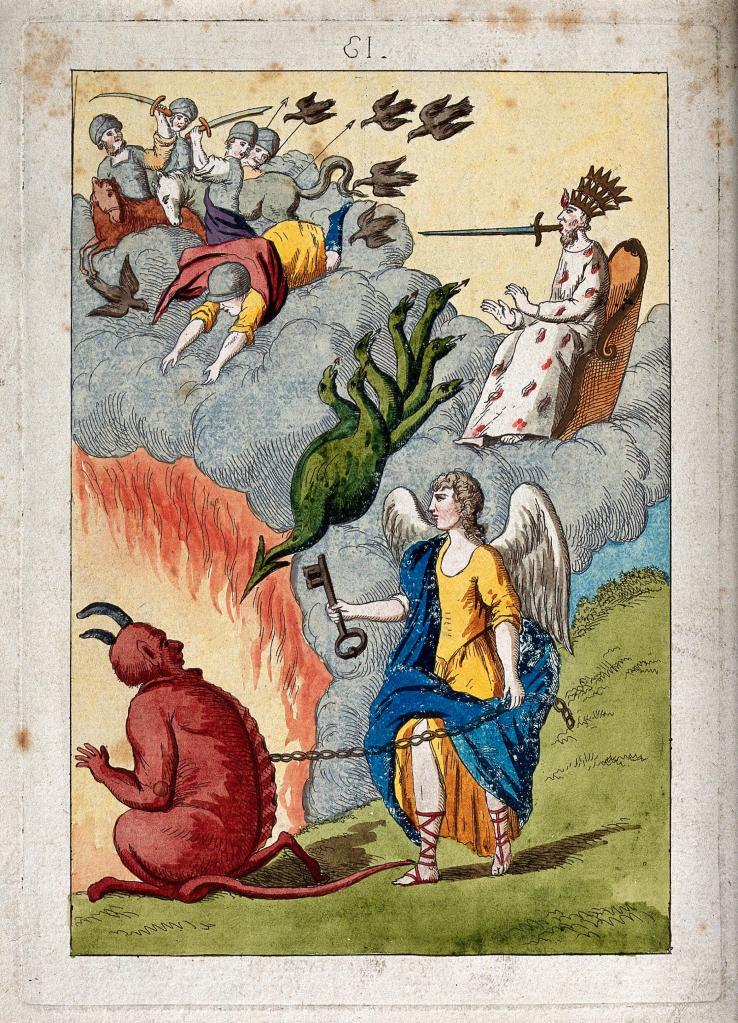
Man is notably lacking horns, fangs, a shell, &c, preferring to invest in a highly developed faculty of observation. He is created in God’s image, and is the firstborn of our mercury, over which His Spirit moved in the beginning. The city is where the lot of natural perturbers were subdued, but the ghosts thereof plague him regardless in the form of energies unconsumed by forgone civilizing labors. Furthermore, the city is the furnace of the Christian Great Work, where the secret fire, fanned by surpluses of Communion Sacrament, animates the grain-fed horde in acts of good and evil. This was described in the Argument of Blake’s Marriage; convenience nourishes a vile lumpenproletariat, rich and poor, which has forgotten what it means to live and now terrorizes those who thirst after authenticity. In general, they condemn the acquisition of what they feel would destroy them, and those actions which they themselves would be ashamed of performing, most pertinently the achievement of greatness. Baked into this reproach, which they at some level feel is charitable, is the assumption that we are undeserving of power and pleasure. We find ourselves torn between social duty and fear of God, for if we assented to their influence, we would incur mercury’s corrosion, which they, considering it inevitable, have named aging to justify their corruption. We, the Sons of Science, interpreted their attacks as generous corrections of our own waywardness for as long as we could before concluding the phenomenon was actually their despised life departing them to seek our hospitality! or at least this is what our learned professionals imagine to console themselves in the face of the unexplained.
Though the Redeemer was mocked with a crown of thorns, He was nonetheless crowned and the extremity of His Passion, moreover, is clearly a measure of what His persecutors thought He was capable of enduring. In the same way, we resort to Philosophy and discern that their slights and mockery are suggestions of our superiority. I will now describe how they confess their sins to us, hoping to make us into a new First Estate. The excitement resulting from our perceiving their attacks, which is proportionate to our estimation of an assailant, and which formerly embodied the qualia of pain and humiliation, now regenerates the sincere signatories of the Social Contract, who have died. Having suffered this, and having been endowed with the criterion that was the ideal result of circumcision, we can no longer mistake these bluffs for legitimate reproaches. Our assailants at once empathize with us, admire us and despise us. Thus they detect our intrinsic energy, which would cause them to sin if they embodied it. While they lazily flattered themselves, we developed personhood by endeavoring to determine the causes of things: the study of fate, limitation and the past. For this reason, their assumption of their superiority, which they, confusing themselves with us, represent as one of equality, is all the more ridiculous. A parallel moral axis is being discovered.
Then, hideously, they pose as if they’re defending themselves from what they themselves would enact if they embodied our potentiality. This vehemence they stole from innocence itself, and the fixity against which they brace themselves is essentially a Fifth Commandment defiled by a corrupt people. Love is not love. Every word is poisoned. Now their children gouge out their eyes to envision a world as dark as the womb. Their esteeming of appearance and disregard for credential … must be corrected and quickly. But I digress. Restrained by this conception of similitude, their violence is subtle and half-hearted: an expression of purposelessness, of interior filth, of mismatched ranking and a paradoxical mixture of dominance and subordination. Since they lack the nobility to realize the contradiction before incontinently acting in this unintelligible manner, we must esteem them to be as worthless as language is in this day and age: the denouement of the excitement their actions cause in us, which again is proportionate to our conception of their worth.
Dispassionately, then, their aggressions are fleeting manifestations of metallic mercury (as sulphur), which gain fixity during alarm due to an abhorrence of life and greatness, within and without, in conjunction with their perception thereof. Should this occur chronically, adaptation begets a chronic rigidity of the concerned organs, as Reich discovered, and if generationally, modification of the skeleton even results. But long before then, the base, hoping to be liberated from this tension, lash out at us, concluding that their perversion originates with us when we, like the Redeemer, permit their aggressions. They have imposed on us to buy their sins, effectively, and if we avenged ourselves, we would suffer the consequences of sympatheticonia. Though they may momentarily enjoy their gravitas and catharsis, they have further reinforced their resistance against the sweetness of life which we have cultivated, which they are already associate with pain, and have rejected epiphany with violence. Alternatively, we may fight with them, and if possible convince them of the indestructibility of our loving nature, and that their concessions to corruption, their rape of logic and reaction, are not at all universal, that there is, omnipresent, a geometrically proportioned Natural Law State which never asks its citizens to embody dissonance of will, and that God is with us always, even to the end of the world.
I hope to have demonstrated my competency in glass-working, the integrity of my Philosophic Vessel, and the asinine power of my medicine that the truly innocent may be convinced they need not ever do violence to themselves at the behest of an aggressor, and that if they do commit this mistake, they can be regenerated through forgiving themselves. I, Frater S.Z., am the Root and Offspring of David, the Bright Morning Star, and so on and so forth.
Finally I would add that as a male, I am not able to contain the mercurial effluxes that manifest as the stag’s horns, the rooster’s comb, &c. What’s more, I am held to be a fool and the runt of the litter, so I suppose no one will object to me expressing my interpretation of the Redeemer’s entrance into Jerusalem, His Crucifixion and Resurrection. It is symbolic, nay, a displacement of the development of sexual excitation and a real orgasm on a macrocosmic scale, hence “If these people held their peace the very stones would cry out.” Being a very pious man, I take no pleasure in being utterly arrested by yearning, which to me is a bona fide Crucifixion, whereupon I permit my total obliteration with the faith that I will rise again.

 sonsofscience.org