1. The Sacred, as opposed to the Profane, sequestered from the Mundane and hoisted above them both, to be constantly aspired towards, and perpetually out of reach, perpetually attacked by the corrosive Spirit of Gravity which won the Body of the Redeemer from the Accursed Tree. But for all the power of the Sacred, it seems suspiciously hesitant to tinge the Profane with its transformative virtue, and decide once and for all the battle with its obviously inferior foe. The Good, after all, is good, and likewise, Evil is evil.
2. The proposition of our Faith is most perplexing. You accept, free of charge, the most excellent and pleasant condition, Salvation – or its alternative, so reminiscent of the fates I often wished would befall my oppressors, who used their powers to compress the incompressible. One would have to be a complete idiot to be seduced by the latter, and it would seem that only our drives could cloud our better judgment in this regard.
3. The metabolism of motivational energy, in its journey from the Sun to our shit, is the principal problem in civilization. It is the central preoccupation of all Law Givers, from Noah to yours truly. We want to maximize peace, fairness, joy, stability, prosperity and honesty so that the best part of our nature can let its guard down. The prohibition of acts destructive to life, limb, property and trust has shown limited effectiveness, as has speculating on their metaphysical causes. Often presented in contradistinction to the Law is the Gospel, whose efficacy is equally questionable. The behavior, past and present, of those who occupy themselves with this narrative does not seem to suggest it’s the be-all-end-all, nor does it seem to prove the Messiahship of the Nazarene. The drama of history appears to have continued unabated, especially for the poor Jews; despite their cursed status and vast spiritual disadvantage, Christianity implies they could be restored by assisting its Messiah in their own evangelization! “Blessed is he who believes without seeing,” and I encourage you all to extend this faith to me also, and not resist when it comes to my supremacy either. But this comment directed at Doubting Thomas, who asked to probe the Holy Wounds with his finger, does not align with the very act of recording the testimonies, with their epilogue forewarning that the Jews will claim disciples took the Body from the sepulcher. It is a sentiment which does not concord with the necessity of the credential of Resurrection to seal the posited Ransom and prove Messiahship, or with that of the physicality of the multiplied bread and fish.
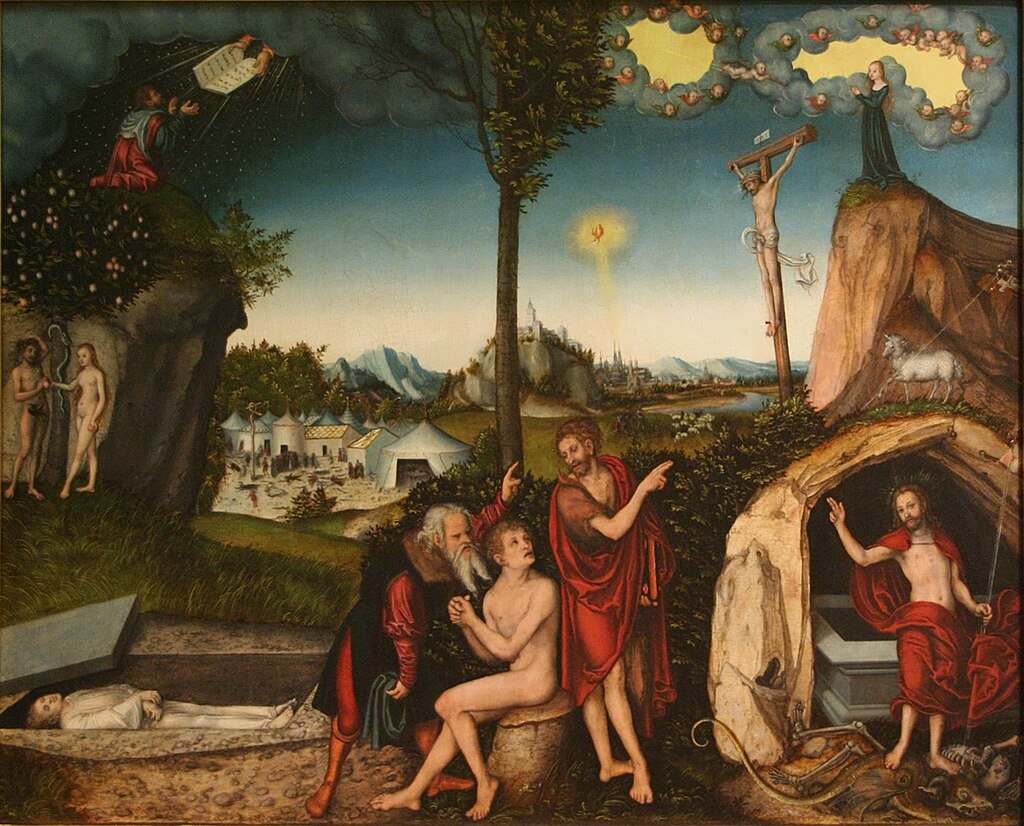
4. First the evangelist insults, stating that one’s soul is imperiled. Then he offers the antidote: become like him and join a religion in which he has seniority. Disregarding observation, with no recourse to experience, leaving fidelity behind, he sees everyone as depraved and for three reasons; his religion says so, he intuits that he is inwardly depraved, and he wants to guard himself against the possibility that this depravity is not universal. There are those, however, who would register the premise, the positing of imperilment, for what it is, and decide that the whole interaction is rather one-sided, that although it may take the form of a friendly warning, it really represents a garbling of natural reactive faculties that have rational functions in the world, and a desire to garble them in those with more internal consistency, thus achieving some catharsis for a dissonance arising from comparison.
5. The symbolic vocabulary of the Sacred is built on the mundane pantheon of objects and natural processes. First man imagined spirits, powers, in all natural things, the natural world failing to engage the totality of his faculties. Then he took the lightening and the rain and the wheat and gave them to the gods. He fixed pine cones and snakes and birds’ wings to shafts from his agricultural tools and gave them to Dionysus and Hermes, implements of impossibly different work. The quantities of things and the variations and combinations of curves and lines, numbers, symbols and letters, he raised up to heaven. In other words, he relegated them to the Sacred; he esteemed them.
6. Strangely, he found that these gods delighted in him destroying what he valued and worked for, the sacrifice of bread, oil, animals, and in some cases, humans. Having harmed his property and humiliated himself, he expected other pursuits, perhaps in the domains of Neptune, Mercury or Mars, to be more fortuitous, for if he went in arrogantly and with all he had worked for, some force might find fault with him and have him shipwrecked, bankrupted, or crushed in battle. He dares Fortuna to strike him down a second time, having done it himself already. Here we find the foundation of Science, which concerns the causes of dangers, their mitigation, the accomplishment of works, and the continuity of life, which, for the elite, is the fostering of its erotic virtue.
7. Whereas today it is considered egomaniacal to claim to have received revelations from God, in the Bronze Age, it was a mark of humility to credit Him with one’s own idea, and the atheist may claim this is what Abraham did when he conceived of the next major innovation in the art of sacrifice. This ascription to the divine indicates a compartmentalization of man’s being, a disavowal of all the power, all the excitement, which he could not embody without being broken or made to act in a way impermissible to his person, to how his father made him, and the relegation thereof to the other, be it in animism, paganism or monotheism. The foreign natural bodies animated by spirits and gods are those assemblages of desiring machines which we cannot penetrate or manipulate by the same will with which we move our own, and it would seem our incapacity in this sphere is due to our preoccupation with other investments. Perhaps to the shaman, the prophet, and Wilhelm Reich, we are as paraplegics, or have other priorities. What, then, is the effect, and the cause, of considering all these powers as a single, omniscient, omnipresent, omnipotent God?
8. While the persons of the pagan pantheons arose from man’s endeavors to effect through sacrifice desired outcomes, the separateness of these persons reflects the separateness of his needs in different spheres. New gods were invented and new cults formed as needed, but if all those spheres were really proper to one God with a singular set of demands and a Science of meeting them, the prospect of mastering the world gets closer to being realized. This is the main thrust of Jewry. Included in the world, however, is His Self, which sabotages him when His will is divided, for better or worse. Ultimately, the only undertakings God favors are those which help restore humanity to Paradise.
9. This ostensible self-sabotage arises from the conflict that exists between the person wrought by condition and the essential nature, or in St. John’s words, “he who was here from the beginning.” It has appeared as the Dionysian catharses of the masses: Sodom and Gomorrah and the worship of the Golden Calf. The bizarre festivals of medieval Paris, saturated with pagan imagery, were intentional discharges of this non-constructive energy: a sacrificial custom anticipating the inevitable failure of repression, and complementing the sacrifice which is the cornerstone of our religion. The mass killings of the last century were discharges of the same energy and took place in cultures that lacked the former’s wisdom. It would seem the sacrifice of God’s Lamb was not sufficient to preempt these tragedies.
10. Man’s repeated disappointments in the mundane realm have inspired him to contemplate a Soul separate from the body. In the darkness of history, the body with its irrational drives – its discomfort, its hunger, its ungratified sexual desire, its poverty and jealousy, its grueling work, its being hacked up by swords – seems to be the source of all misery. His inner faculty of estimation resists all these things, and he reasons that this world is a lie, that he did not really suffer all these offenses, that he will never be obliterated, if only at the most ethereal level. Do I come to you saying there is no Soul? Do I come to take from you the last thing that you have, your Soul? By no means! Rather, I say there is no body, that it is all Soul and that your Soul has suffered these things. That night, when the Redeemer conversed with Nicodemus, saying “that which is born of the flesh is flesh,” He was speaking as one circumcised man to another.
11. The primordial experience of the womb, juxtaposed against the horrors of this world, sets the stage for this inner conflict. We attempt to console this expulsion from Paradise by material and spiritual means, fleeing before godlike pain. There are those who are aristocratic and beautiful, with flowing œconomies, the fruit of fine families and a gentle regard for life. Then there are the more conflicted, the more harmed, who recourse to the technical, the scholarly or the mystical, the impermanence of that world and the immortality of the Soul, the self independent of condition. The trap of immoderateness swallows all but the most subtle.
12. The self independent of condition, counterintuitively, is what must die in order to resolve this conflict. Having been conditioned, its virginal state has already perished; it no longer exists in its pristine iteration. This process can be likened to God being made flesh, rejected by the World, accused, made to carry His Cross and killed, if I may dare say. The Jews, however, circumcise before this can happen. Just as one eludes disaster while sailing from Attica to Tyre by having sacrificed to Poseidon, this procedure is what saved Isaac from his father. He that has ears, let him hear. I would also contend that the celibacy of Jesus Christ was due to a combination of circumcision and His discovery of the unconditioned, and that the great error of Christianity has been to esteem celibacy over marriage. How wonderful would it have been if He took a wife after conquering death?
13. The true desires of the human organism, denied and concealed by necessity and convenience, have grown rancid, terrible and monstrous, and their potential to surface evokes another primal instinct: to freeze. Emergency measures must be taken to stop this gluttonous, vengeful, lustful aspect, and this is considered good, this facade of moderateness that only the truly moderate can penetrate. In point of fact, these so-called sins are merely distortions of natural capabilities: self-sustainment, honor and sexuality, respectively. The evil qualia of the unconscious can only be eradicated by the exercise of these faculties, and their repression guarantees its permanence. Furthermore, Good cannot be a mere reaction to Evil; it must be positive, primary and have intrinsic incentive.
14. My friends: we have died. We also have made the ultimate sacrifice. Nothing can console our loss, so let us take all that we can. Let us discover the true Science of Sacrifice, the true Science of Life and make all things Sacred. The infinitude of God dwells within us. Take courage that it can tinct the Profane in a Great Transmutation. I will close, then, with lyrics from a brave undertaking of the secular, a commendable attempt to meet you up there: the Finale of Mahler’s Resurrection Symphony, translated from the German:
Die shall I in order to live!
Rise again, yea, rise again
will you, my heart, in an instant.
What you have suffered
will carry you to God!

 sonsofscience.org