Frater S.Z. to the Sons of Science: Peace be with you!
So, the former Queen of Hell has since gotten married, and worse still, became a Lacanian. I couldn’t sleep and felt as though I were dying for a few days after I found out, but I already knew deep down I couldn’t be her husband. That was my foremost hope for almost a decade despite being unable to recognize it until a couple of years ago. However, I found that I could not make another move toward her, so immense was the related pain and fear. My only complaint is that the wedding should have been delayed or advanced a week out of respect for me, because it was ten years to the day from when we first kissed in the early morning after the Seminoles defeated the Fighting Irish. Surely that was a benign coincidence, like when she wore a white dress the last day I saw her, although it makes me feel I count for nothing and that my Soul really had been extinguished back then. At the same time, I’m sincerely thrilled that she can enjoy the certainty of being loved by one man for the rest of her life and beyond. That, ultimately, is what’s most important to me, as regards this situation. Aren’t I the greatest, I must ask right away? And so another chapter concludes and a new one opens… I feel the strangest admixture of sorrow and awakening, that the ice of my heart is melting. I revel in the sadness which I haven’t been able to feel for so long. In other news, I’ve committed myself to learning the art of metallurgy and established a refinery specializing in the recovery of silver, and this led to what may have been an extraordinary occurrence, most significant for someone attempting the Great Work. It is one which I would like to share with the Sons of Science and all who believe in my ways, the elite few who understood and remembered my works and spread my renown, and with those who also have possessed at some point the inclination to, in the words of Nietzsche’s Zarathustra, create over and beyond themselves, and thus perished.
– S
* * *
The importance of sobriety in the Hermetic Science is emphasized by Geber in The Sum of Perfection, attributed to Pseudo-Geber by scholarship. He begins the tract by describing impediments of the Soul which prevent the Artist from accomplishing the Magistery, of which the most pertinent to our discussion is as follows: “we also find many who have a Soul easily opinionating every Phantasie; but what they believe they have found true, is all Phantastick, deviating from Reason, full of Error and remote from Natural Principles: Because their Brain, repleat with many Fumosities, cannot receive the true Intention of Natural Things.” Similarly, Fulcanelli writes in The Mystery of the Cathedrals, while discoursing on the statue of St. Marcellus in Nôtre Dame de Paris as it relates to the Dry Way, “the science, which we are studying, is just as positive, as real and as exact as optics, geometry or mechanics; its results are as tangible as those of chemistry. In it, enthusiasm and private faith may act as stimulants and valuable helpers, but if they enter at all into the conduct and direction of our researches, we must not allow them to introduce any deviations. We must subordinate them to logic and reason and put them to the test of experience.” Finally, we have Cyliani in the preface to Hermes Unveiled stressing the tangible nature of this Art by partially crediting his success with the Philosophers’ Stone, and reunion with his Wife, estranged by his insanity, to his material study of chemistry, as opposed to the mystical and Jungian ideation associated with Alchemy today – for what good is a spiritual transmutation, or a Messiah who saves only the Soul and not the Flesh, and I mean really saves it? From the advice of these three Magi, one should conclude that skepticism must be exercised when one encounters in mundane laboratory work the unusual appearance of a material resembling gold.
Some four months ago, I was stripping silver-plated wares in a bath of nine parts 66 °Bé sulfuric acid to one part azeotropic nitric acid (I now use a 3:1 ratio because it is faster). The working principle of this bath is that above a certain concentration of sulfuric acid, a protective, passivating layer forms over brass, nickel silver, and copper, but not silver, protecting the former from the nitric acid while the silver is oxidized and dissolved thereby. The bath then holds this silver as an acidic solution of silver nitrate and silver sulfate which can be purified and reduced through hydrometallurgical means. Now, after several pieces had been stripped of silver, I returned to the fume hood and observed what looked like gold leaf floating on the surface of the bath, which is over one and three fourths times as dense as water. I scooped out the leaf with a polypropylene strainer, rinsed it, and transferred it to a gold pan. Shaking the leaf in the gold pan with water, I observed that it sank but did not behave like the gold I’ve found prospecting in the Berkshires, which, by virtue of its large specific gravity, instantly seeks the lowest regions of a gold pan, but this is to be expected of metallic leaf, whose surface area and thinness permit buffeting by currents.
Naturally, the next experiment was to attempt to dissolve it in hot dilute nitric acid, as dissolution would rule out gold. No reaction was observed, no bubbling, no brown fumes of nitrogen dioxide, and most significantly, no coloring of the water with metallic cations such as the blue copper(II) ion or the green nickel(II) ion. This result strongly indicates gold.

I know. I should’ve gotten a better picture of it.
Next, I added muriatic acid to the nitric acid to form Aqua Regia, and this, promisingly, dissolved the metallic leaf in question. Aqua Regia, Royal Water, is called so because it can dissolve gold, which the Alchemists thought of as the king of the mineral kingdom. Neither acid can dissolve gold by itself, but gold is slightly oxidized by nitric acid and the chlorine that forms when Aqua Regia is prepared, whereupon it reacts with chloride from the muriatic acid to form chlorauric acid. Concording with the Principle of alchemical skeptic Le Châtelier, the removal of the ionic gold product via the formation of chloraurate shifts the equilibrium of the gold oxidation reaction to the products, allowing for the dissolution of more gold so long as there are sufficient concentrations of nitrate and chlorine (the oxidizers), chloride, and acidic protons (to lower the reduction potential). Even still, the mystery species could have dissolved under the influence of the nitric acid alone, now that it had more time to react therewith. I should have heated it for longer in nitric acid before adding the muriatic acid, but other observations suggest the metal was gold regardless. The Aqua Regia maintained its characteristic yellow color (it appears yellow, orange or red, whether or not it is pregnant with gold as chlorauric acid). There was no green hue from copper chloride or nickel. Lead would precipitate as lead chloride and would not have, in metallic form, had the appearance of gold leaf, namely the yellow color. Platinum would not appear yellow either. Tin would have formed metastannic acid with the nitric acid, which is a crystalline solid insoluble in nitric acid and Aqua Regia. The other non-cupric base metals would not have survived the original bath, and cupric alloys would have been passivated, remaining in the structure of the ware (or only very slightly dissolved). No silver chloride formed in the Aqua Regia, ruling out silver. Above all, the metallic leaf did dissolve in Aqua Regia, and any inconclusivity from the nitric acid test is ultimately rendered irrelevant by the properties of the stripping bath and of nitric acid and Aqua Regia, the absence of colored metal ions, the absence of silver chloride, and the original gold color of the leaf, which together, in my opinion, rule out all metals save gold.
Regarding the buoyancy of the leaf, the bath is very dense. The species comprising it are polar and very prone to hydrogen bonding, which is to say the bath probably had an immense surface tension. The leaf was very thin and laying parallel to the surface so I think the fact it was floating isn’t incompatible with it being gold. Flotation says nothing about the specific gravity of the metal, only the difference in specific gravity between the bath and that of the volume enclosed by the leaf, like how a steel battleship can still float.
Gold leaf is not a part of the silver-plated ware manufacturing process, though plating may appear leaf-like when it peels off. If the leaf was silver, it would have dissolved in the original bath. If it somehow survived this and the nitric acid test, it would not dissolve in Aqua Regia so quickly, as it would be passivated by a layer of silver chloride. If the leaf came from a base plating layer of another metal, it would still fail the qualitative analysis described above. Gold may exist in trace quantities alloyed in the base metal, but if it was liberated in a meaningful amount, it would appear as a fine brown powder, as it does after precipitation from Aqua Regia, not as a gold leaf. Gold powder does not take on the appearance of yellow gold until enough of it is melted together, though it has been observed to fuse at far lower temperatures. Speaking of which, the next step was to attempt precipitation with sodium metabisulfite. I added an aqueous solution thereof and observed no precipitate. However, the solution was probably too dilute as the amount of metal was only a few grains, and I did not wait long enough for any gold to settle. I poured the solution into my stock pot. Regrettably, I did not have any stannous chloride at the time, thinking my work would be mainly argentic. That indicator would have put the mystery to rest in an instant. The experiment was ultimately inconclusive. One can speculate that my haste suggests I harbor some hesitancy and do not want to accomplish the Magistery on some level, perhaps due to the implications such a thing has. Also, I should have tried to melt it with a flame.
In my extensive study of chemistry, I have still not encountered anything that refutes the possibility of the transmutation of base metals into gold on the scale written of by the Alchemists, one of Troy weights, not the nuclear transmutation performed by Seaborg, which produced several hundred gold atoms from lead. Furthermore, I have delved into highly technical and theoretical concepts to showcase my dedication to that science next to my open-mindedness concerning the possibility of transmutation. That said, I have very much to learn about metallurgy. The identity of the material still being unknown, I would add that the only operation I attempted before its appearance and the experiments this inspired was silver-stripping in the bath of nitrating acid. There was no projecting agent used, like that mentioned by the Alchemists, no intentionality, and the substance never appeared in any stripping bath before or since. I will be on the lookout for more auroid bodies.
* * *
Sir Francis Bacon wrote in Axiom XIX of the Novum Organum, the New Organ, or New Machine, that “there are and can be only two ways of searching into and discovering truth. The one flies from the senses and particulars to the most general axioms, and from these principles, the truth of which it takes for settled and immovable, proceeds to judgment and to the discovery of middle axioms. And this way is now in fashion. The other derives axioms from the senses and particulars, rising by a gradual and unbroken ascent, so that it arrives at the most general axioms last of all. This is the true way, but as yet untried.” But is this axiom arrived at by the way he advocates, and is it really the true way, really possible?
The first is the way of Aristotle and Aquinas, by syllogism, deductive reasoning, which is effective for some purposes, but not for kinematics. For example, that Virtuous Pagan said bodies naturally come to rest if not compelled by an external force, perhaps having posited as a major premise that bodies seek their natural place. Experience confirms this, but Galileo observed that balls rolling on different surfaces decelerated to varying extents, variables controlled. While Aristotle’s observation is valid, it’s not the whole story, and if one’s schedule allows, one may choose to pick apart aspects of the scenario. Newton would later say that these bodies come to rest because they are opposed by a force (friction) and inferred that they would move forever if liberated from the constraints of the world: his first Law of Motion. Modern science considers this an insight into the true nature of bodies; if the extent of the opposing force is really a property of a particular surface, spontaneous deceleration may not be proper to bodies at all. Here we have certainly deviated from Bacon’s “unbroken ascent,” but what do we get from turning the Peripatetic position on its head and imagining a hidden principle in nature? Before this can be answered, we must examine Newton’s application of mathematics to the physical, something Aristotle disdained. Measuring time, length, force and temperature, and deriving units of mass, velocity, momentum, acceleration, work, area, volume, density, &c., and ascribing numerical quantity to phenomena, and discovering or inventing the formulae that relate these quantities through Algebra and the Infinitesimal Calculus creates a circular, self-referential structure of equations capable of modeling ideal situations: physics.
It is important to note there are no frictionless surfaces on which Newton’s inertia can be showcased in its pure form. By his framework, no body is insulated from gravitational attraction either, though perhaps beyond the Seventh Heaven, this force from the remote worlds may be so weak that his inertia can finally manifest, for our lay-purposes. Only out there, away from everything that matters, can the true nature of a body be unveiled, but never completely; there is no limit to the gravitational range of a body – no matter how small, it will pull on every other body in the cosmos. In the same way, there is no mass separate from weight until we consider weight, which has always meant the amount of matter, to be a force, and call the amount of matter mass. This can only be done concurrently as force is being defined: the mass of something in his mechanics is a body’s resistance to being accelerated by a force, and the weight is the force a scale must exert on a body to bring it to rest in the presence of Earth’s gravity, and this force is the product of the mass and the magnitude of the acceleration with which most bodies fall to Earth despite the fact that this body is at rest on the scale. This curiosity, that the resting body has an acceleration of zero so we force upon it the acceleration it would have while falling in order for it to have a non-zero weight, arises from the fact that we have elsewhere assumed that constant velocity, be it rest or no, is the result of balanced forces, and if the body is at rest, the forces acting on it must be balanced. The Baconian Method has been thrown out the window, along with the hope for a New Atlantis! We have fallen into the habit of using general axioms to derive middle axioms. Worse still, we have returned to Aristotelian syllogism. The equations become subject-predicate statements like “the net force acting on a body (F⃗net) is (=) the product of mass and acceleration (mā⃗ ).” Tracing the Newtonian argument dealing with weight, we can say:
- Weight (W ) is (=) the product of mass and g (mg), where g = 9.8 m/s2.
- Acceleration ( ā⃗ ) is (=) the rate of change of velocity, the derivative of velocity with respect to time (dv⃗/dt).
- The net force acting on a body (F⃗net) is (=) the product of mass and acceleration (mā⃗ ).
- When the velocity is constant (dv⃗/dt = 0 m/s2), the net force acting on the body is zero (F⃗net = 0 N) and so on.
The difference is there is no starting point, no procession from first principles, which can be wrong, a great concern of Bacon’s. The weakness of deduction is that the premises must be correct for a true conclusion to be reached. Induction gives specific conclusions about large data sets such as Brahe’s observations of Mars, in which Kepler almost discovered the correlation between the square of his orbital period and the cube of the length of the semi-major axis of the ellipse he traces. But Newtonian mechanics is not derived in this way either. There is procession, but it is circular, like the post-structural conception of signifiers, and strangely, it would seem nothing has been written on the actual derivation of these laws. Could that be possible? And those who try to explain it cannot do so without regurgitating definitions, referring to later discoveries (especially relating to outer space), using the complete framework to explain its derivation after the fact, tracing the relations in endless circles, conflating terms, and resorting to sleights-of-hand and fallacies. I am considering going over to the next valley and visiting Yale University to see if one of the learned scholars there can explain it to me. Surely in those stunning Gothic halls, they have kept to searching into and discovering truth… Anyway, for now I shall conclude that Newtonian mechanics does not arise from observation and inference. It equates a real quantity like velocity to the quotient or product of a real quantity and an abstract quantity like momentum; it creates new quantities by dividing preexisting ones into components. It is tautological, a shell game, and says nothing new. The whole body of scientific knowledge is still no more insightful than the Emerald Tablet.
Newton also has made the assumption that the intrinsic property is the one whose quantity does not change in different conditions. Why? I can just as easily say that the mass of something is an expression of its weight on Earth, where it matters, but here I am just playing Ahriman’s advocate.
The Scientific Method is said to rely on inductive reasoning, that conclusions can be drawn from repeated experiences and observations. Although this is not always exactly followed, we may experiment repeatedly and eventually state that there are laws by which phenomena abide and generalize these into theories, unified frameworks. We may say that there are properties proper to processes, bodies and substances. But as Hume declared, there is not a shred of evidence that they always have these properties, no matter how many times they are observed to have them. It can never be known whether the laws of physics and the sciences derived from it are immutable or eternal. Instead he advocated for a Science of Man that investigates not just external phenomena but the observational faculties that apprehend them, which we may trace through Kant, Hegel, Schopenhauer, Nietzsche, Freud, and Reich. Equally troubling is the fact that the particulars, the specific aspects of phenomena which are the targets of Baconian inductivism and the subjects of scientific statements, are revealed by increasingly unnatural situations in artificial apparatuses. This problem is most apparent in quantum physics, which may want to consider caveating its declarations about particle composition and “the fundamental nature of reality” with “if they are collided in this multi-billion dollar machine.” I liken this to throwing pottery against a wall with increasing force to find the elementary pottery shards. Is it still natural science at this point? Do apparatuses unveil latent properties or do they combine with their contents to create new ones? In Nietzsche’s words, “supposing that Truth is a woman, what then?” Just as a woman may do everything to make you think she loves you only to dispose of you, so too will Truth unless you regard her as less than nothing.
Ultimately, it is merciful and charitable to see bodies as being intrinsically weightless and having constant velocity. It’s those forces keeping us down! In the Enlightenment it became as distasteful to rule over the slavish (at least in an obvious way) as it was to proceed from gross interpretations of sense data. It became fashionable to look for deeper truths in everything. Last year, this reached its aphelion with the social sciences portending that an ignoble person can be completely transfigured if various inputs are adjusted. A Shudra can become a Kshatriya if only he came from a good family, had everything about him changed, if he were completely overhauled, if there was enough money to pay for it, if there was enough time and expertise, in short, if he were already a Kshatriya. This is a variation of Marxism: if the proletariat stole the property of the bourgeois, they would save the world. But whereas modern social science offers vile platitudes tinged with a faint but cynical, nasty and sarcastic tone, while it enables corrupt officials to enrich themselves with money extorted from hard-working people under threat of imprisonment (taxes) as it flows through allegedly charitable programs, as the wretches they traffic in are further debased by the phármakon of do-gooding for the sake of expanding their ponzi schemes, orgonomy holds the same position while offering true care. Indeed, its practitioners have seen the very structure of skeletons change. It beautifies the ugly and makes lovers out of the impoverished, and does so by never, ever saying “that’s just the way it is.” That is to say these transformations depend on the total rejection of the concept of the innateness of the so-called Thanatos. And if we observe that organisms live for varying durations (based on the adroitness of libidinal economy), just as balls have varying decelerations, we can induce that death is not proper to life either, but I digress. By conceiving of velocity change as the concomitant of unbalanced forces acting on a body, we unleash a Pandora’s Box of technological proliferation in the shadow of the inadequacy of the Church founded by St. Peter. It is the basis of mechanics, electrodynamics and thermodynamics: the modern world. These may describe the Sun’s periodic alteration of the viscosity of the Earth’s mantle by its electric field, its loosing the crust from its bonds and reorientating the continents, tropics rotated into the arctic and vice versa, and when this violent motion finally ceases, the oceans, laden with inertia, continue in their trajectories before coming to mechanical equilibrium with the low places.
* * *
My friends in the Eastern Orthodox Church suffer from an interesting condition. It is not enough for them to be saved by Jesus Christ. They feel they must also take away the religion of the Jews. It is their religion to believe they’re superior because it was not written that their ancestors said to Pontius Pilate that Friday of Mourning, “his blood be on us and our children.” I shudder to think of what personal impoverishment could inspire someone to hold the Blood Curse against every Jew, but as it stands, they think we are the ultimate idiots for rejecting our alleged Messiah and killing Him, thereby enabling their Salvation. Like Wotan and Loge, they made off with our Ring, but did not have to forswear love themselves! How they roared with laughter at the symposium after I read “especially for the poor Jews.” That was not a very becoming reaction from those who purport adherence to the ultimate spiritual system and, along with other observations that have been accumulating, it made me very doubtful of Jesus’s salvific power. It made me reconsider an idea which I have always despised: that the Jews are God’s Chosen People.
Perhaps the most natural refutation to the claim that Jesus of Nazareth was the Messiah is to point out that He did not usher in the World to Come, though this is easily resolved by adopting a non-Judaic definition of Messiah or saying He will in the future. Instead, one extremely slippery mystic replied to me that the Jews are a materialistic people – and this may explain why I love silver and gold – and that they expect a material Messiah, Antichrist. His Messiah, contrastingly, is one that saves the Soul, which is higher and spiritual, adding nothing to the conversation but time. Shortly thereafter, said he, Jesus will come down from Heaven and fulfill the rest of the prophecy put forward by St. John. I had naively assumed that the Jewish Messiah and the Second Coming were the same Person, but unfortunately we will not be able to see the result from the Lake of Fire.
Jewish Tradition has it that the Messiah will be born, unfortunately for Him, to human parents, and this, it is implied, as the result of male ejaculation. He will patrilineally descend from David and Solomon, from the Tribe of Judah, restore the Monarchy of Israel, build the Third Temple of Jerusalem, abolish the holidays, the Law and Circumcision, and marry an unchaste woman. He will appear at the end of the Historic Period as the World is perfected, an idea which the Jews may have adopted from Zarathustraism through the Persians who liberated them from Babylon. Whether all this is true or not, I do not know, but one can see that there are certain advantages to believing in a Messiah who only comes at the End of the World. That being said, if any person could appear more than once in history, it would be the Person of the Messiah, which has its origin not in the crucible of the oedipal situation, but earlier in Immaculate Circumcision, such that all the cathexes of character can be shed in adulthood. He is a Person who embodies from the eighth day of life the sacrifice which our rulers and managers allegedly make to justify their authority.
Anyway, I will attempt to illustrate my point about believing in a Messiah who only comes at the End with an anecdote and an argument. Truly, I am an eternal student on a life-long journey of learning, and recently I learned that Christianity actually predates Judaism, and that, what is more, Judaism is a reaction to Christianity! One would think, believing in the veracity of the New Testament, that it’s the other way around because Judaism was operative during the events of the Gospel which precede the Acts of the Apostles, the founding of the Church. Thankfully, the slippery mystic was able to enlighten me and correct this confusion, and all the while I faithfully followed his argument with diligence and attention. My mistake, he said, arises from the fact that Rabbinic Judaism, the current iteration of the religion, “ideologically descends” from the Pharisees; therefore, it is based on the rejection of Christ. As you may already see, this is a non-sequitur of the form given by Geber in The Sum of Perfection: “An ass runs. Ergo, thou art a goat.”
Now, the Jews loved Alexander and were happy to let him govern Judea so long as they could practice their religion in their own way, but when he died, his empire fragmented and the Seleucid House came to power in Asia. After several generations of rule, Antiochus Epiphanes was crowned, and one of his first acts was to sacrifice a pig to Zeus in the Second Temple of Jerusalem and force the High Priests to eat its pork. This with his imposition of a Greco-Judaic syncretism enraged the Jews, inspiring them to rebel under Judah Maccabee. They expelled the Seleucids and Maccabee’s nephew went on to establish the Hasmonean Dynasty, the last Jewish Royal House to rule Israel. The Sadducees were its official priesthood. The Pharisees, a competing faction, were the ones who opened the gates of Jerusalem to Pompey in 63 BC, after which they slew the Sadducees in the Temple and became the new priesthood. According to the Gospels and a few other sources, they petitioned the Romans to crucify Jesus during the reign of ethnarch Herod Archelaus, which the Gentiles say enabled their Salvation. After the Romans razed the Temple (which had stood for over five centuries) in the year 70 AD, Rabbinic Judaism evolved to address the religion’s ritual center being destroyed as it spread all over the globe. So it can be said the basis of Judaism before and after Christ is the Covenant made with Abraham and the history and Laws laid out in the Torah and the Tanakh, which include the Ten Commandments, not the rejection of Jesus. Judaism would consider my friend’s Prime Mover to be little more than a footnote if He were not, ultimately, the justification for all the massacres, exiles, and property appropriations the Jews suffered in Europe.
It is interesting that the pagan Gentiles would be so moved by these accounts of a heretical rabbi and that they preferred to compliment these accounts and His sayings with the concept of Original Sin, a basic badness supposed to be innate to all humanity, one that, rest assured, everyone else also has. It is a posited primordial lack which arises from a combination of empathy (or rapport) and ignorance regarding the causes of fortune and misfortune. This idea relates to the accusations which accompany the act of putting oneself before another, and the divine consolation sought by those who lose.
In antiquity, the common person seemed basically animalistic but an elementary inversion could be imparted by the study of the liberal arts (the Trivium and Quadrivium), or Initiation into the Mysteries. The public conceived of this as a form of self-denial and developed a mystical reverence for it despite it being equal in value to, albeit different from, their vile existence. The people placed their trust in this class because its craft generally numbed the viscera, making its members appear collected. As time went on, villainous types were enabled by inherited technologies and surpluses to leave the paths of ease, as Blake said, and sully these heavenly things with their base desires, base not because they were bodily, but because they were unproportionate and could be realized through manipulation, coercion, duress, sexual perversion, and so on. This is a component of the emotional plague, and it is rooted in an organism’s elementary denial of its capacity for cathexis and catharsis, for life itself, this being imparted by parents who respond to its appearance with terrifying displays of hatred. Counterintuitively, disabling this capacity prevents a child from developing any profitable skill because said disabling preempts and takes the place of the self-denial with which skill is bought. It is a Satanic self-denial with no reward, immediate or delayed, and it destroys the inborn instinctual faculties, resulting in work that has decreasingly discernible products and the primary function of sublimating antisocial impulses, as opposed to actually doing the fucking thing they say they’re doing.
In administration, it is too easy to impose upon, oppress, and disregard the powerless and the poor. There is nothing worth this unaesthetic expense. Having received the consent of the governed, it is too easy for administrators to put themselves before their country. It’s too easy for legislators and bureaucrats to steal and launder so-called tax revenue. In medicine, it’s too easy to turn the sick into financial instruments. In priestcraft, scholarship, and philosophy – and psychology – charlatanism is too easy; when is a neurosis resolved, meaning when exactly does the analysand stop paying the analyst? how much, if any, of the antisocial is instinctual, and therefore not subject to resolution efforts? It is too easy for so-called educators to racketeer, which is basically all they do when not engaged in outright perversion. Often, even the most sincere practitioners can’t reproach charlatanism because it is too similar to their own work, no matter what the field. I, of course, am impervious to such deceptions, and it’s better to accuse first and let the accused defend himself before you indulge him with the perks of the Brahman Caste, that is, if you want what’s best for him. From the present situation, we can reconstruct that which was in antiquity and infer the following, and this is not to say the inversion I will describe has not recurred in varied forms throughout the cycles of history. Although we collectively assume a relationship between self-denial and virtue as it relates to authority, slowly, slowly, like the Precession of the Equinoxes, the tables, so to speak, can be turned eventually, and we can find ourselves in a society run by vile human-animal parasites. This is the future (or present) global power described in St. John’s Apocalypse, which the angels and armies of Jesus Christ, he wrote, will destroy in one hour at the End of the World: Babylon. Undoubtedly, his dissatisfaction with the early Church’s handling of the new way of being, but more importantly, his detection of the diabolical phármakon of Salvation, inspired this prediction.
The degradation of administrative and professional quality has often discontented the prophets and geniuses. This is an important theme of the Gospels and the Socratic Dialogues, and a key subject of investigation for the Hermeticist, heavily alluded to by Fulcanelli and Basil Valentine (cf. The Triumphal Chariot of Antimony), and less so by Cyliani, with Geber also unmasking the certainty of experts. Ultimately, I discovered, their exile, and insanity if present, is self-imposed and a consequence of projecting their virtue onto those who should be their subordinates. But we will lose track of an almost imperceptible but infinitely important caveat if we equate the Pharisees directly with something like the state, the western university tradition or a guild. That is because they were the inheritors of the theurgy of the Israelites, at least until they paradoxically killed their Messiah who failed to save them but was somehow still their Messiah. The Israelites and their descendants the Jews are obviously a unique people, and are not a people in the way other peoples are because they, as a confederacy of pastoral families from different nations under Abraham, intentionally bound themselves to something they conceived of as supermundane, this eventually giving rise to the theological foundation that most of the world has appropriated and mixed with its folk-modes. This concept, not unlike that of America, was partially expressed by Giambattista Vico when he proposed that the Jews were the only nation to skip over an epoch characterized by a vicious cycle of open defecation, hyper-fertilization of crops, and, in turn, human gigantism.
Though we can assume that Israelitish theurgy had decayed since its most impressive period, the Exodus, it would be a mistake to think that the original Covenant could be replaced by one mediated by Jesus Christ. We are truly fortunate that the Jewish People have persisted long enough for someone to finally put all the pieces together and resolve the World Riddle, because the solution is derived from their striving with the Gentiles, and, what is more, the inheritors of the early Church have let Evil infect every aspect of human life, often in ways which we are too evil to detect. It failed its very first test with the Council of Jerusalem totally botching the issue of Circumcision and it is probable that Christ Himself did not fully comprehend the Sublime Rite of the Jews, barbaric though it may be. To me it seems He put little thought into what would happen after He returned to Heaven, though the subtly of Circumcision’s effect, especially when the circumcised supplicate their antagonists, is easily ignored, and the Pharisees were not compelling enough for the apostates. The main criticism I have of Christianity, and I think the Messiah will agree, is the alleged coexistence of sin with the condition of being saved (from sin) and, necessarily, the separation of the immortal Soul and the mortal body, to wit, death. Salvation should be absolute. Christianity’s symbolism happens upon a profound truth which instantly seizes the Gentile mind, but it loses its salience because it isn’t earned. Its adherents relate themselves personally to the God concept yet are blinded from their enormous illness, hence an infamous Talmudic verse referenced wherever free speech is allowed. Scarcely anyone can see the star spoken of by Eugène Canseliet in the preface to the Second Edition of The Mystery of the Cathedrals, one which shines more brightly in broad daylight than in the blackness of the night. It is discovered by considering all things rather than subscribing to some metaphysics or religion, or ideology, and especially by considering that which we by default loathe most to consider, the repressed. In gluttony and lust do they gobble down and rape the spiritual while the asceticism of the involvedness of True Life, this affording the highest sexual pleasure, is rejected. Are you beginning to understand? The tables have been turned. “Now the Just Man rages in the wild, where lions roam.”
This is getting heavy so time for a joke. Long ago, the LORD went to all the nations of Earth to find one that would receive His Commandments. First He went to India and asked if they would receive them and they replied, “what’s in them?” Thus saith the LORD: “Thou shalt have no other gods before me.” The Indians replied, “no, thanks. We like having many gods.” Then He went to Germany and asked them if they would receive His Commandments. The Germans replied, “what’s in them?” Thus saith the LORD: “Remember the Sabbath Day and keep it holy,” and they said, “we’ll pass. We have work to do.” There are many other variations pertaining to adultery and stealing that I will skip over – feel free to make your own – but eventually He went to the Jews and asked them if they would receive His Commandments. The Jews asked, “are they free?” He said, “well, yes but –” “We’ll take ten!” … but actually, there are six-hundred and thirteen to six-hundred and twenty, and they are not free; the rigor and comprehensiveness of Mosaic Law compliments the injury which is the basis of the Covenant. The latter is a means of disembodiment that was – and probably no man has ever been as intelligent or as daring as Abraham – intended to interrupt the Lapsarian condition, viz. the cycle of castration and revenge, the inversion of the male mind, and the displacement of this vengeance onto the Son, and having begun to arrest this process, the eventual reunion of man with God, this being recapitulated in the Great Work of Alchemy, whose synopsis is the famous phrase solve et coagula et habebis magisterium. Therefore, the Law was necessary, and not because the Jews’ “hearts were hard,” but to organize their energies during the ages spanning the Exodus to the Eschaton, when a return to the Spirit of the Law is at long last possible. That, however, requires the redemptive transfiguration of libidinal economy, which Christianity’s premature return to the Spirit of the Law clearly does not enact. The Letter of the Law was given because the Jews intentionally disbarred themselves from the Spirit of the Law through Circumcision, because the Spirit of the Law was not the Spirit of the Law at all, but too often the turbid, filthy admixture of a terminally mortified cornered crucified instinct, desolate confusion surrounding the life function, and whatever little pleasures can be stolen from someone a little more vulnerable. Furthermore, the Spirit of the Law arrived at by Jesus is not the True Spirit because the bodies of the Gentiles who have a portion in the World to Come must also be saved, and I, for one, will not try to prevent this from happening if I see it unfolding.
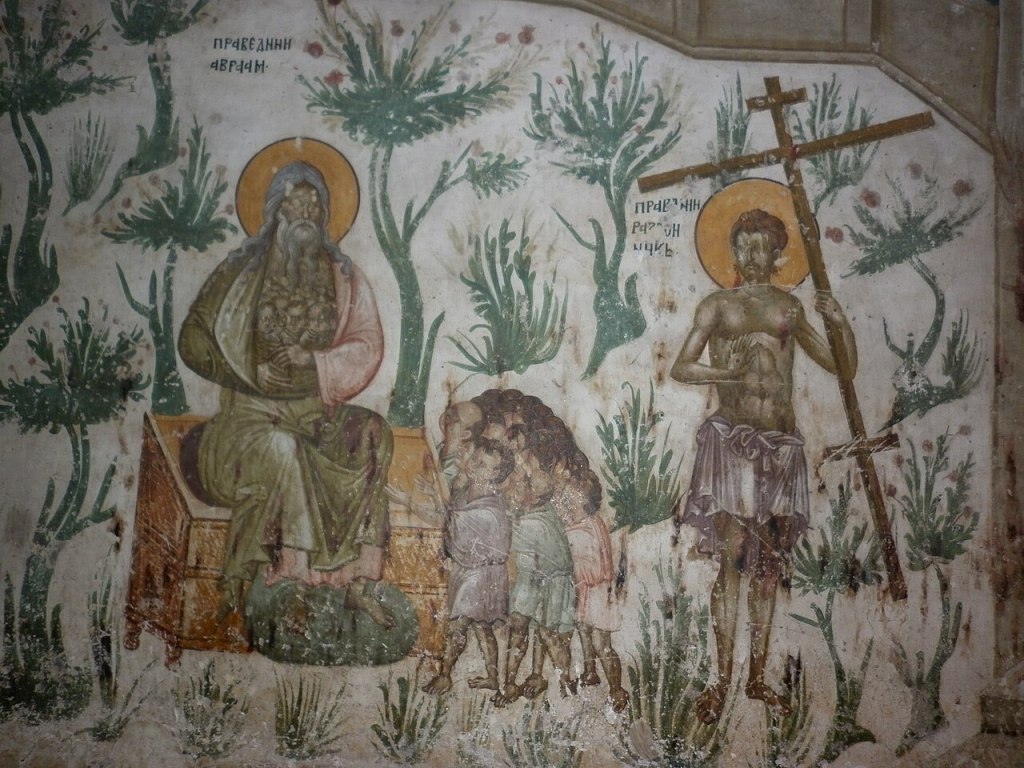
Meanwhile, in Christiandom and Heathendom, and the Orient, and in Africa and the Americas, and in that portion of or perhaps in all of Jewry which forgot the rationale, which I rediscovered through utmost subtly and ingenuity, the issue of what to do with the Son looms large. My friend prattles on about this or that author, heresy, or saint, and a saint who befriended a bear, or a saint who smiled when he died, or befriended a bear that smiled when the saint died, but one need only know what a Son is. Son. Son. Son. If, as the Kabbalists say, the entire Mystery of the Torah is expressed moreso in the first letter, Beth, ב (whose number is two, and which corresponds to house, the House of Jacob or Israel and to walls and separation, an investment of libido), than in the entire text, then the Mystery of Jesus Christ is found in the word Son, or more precisely, the experience it describes, and not so much, if at all, in the peripheral liturgy. This is what Jesus torturously tried to express to His friends, but they, like all friends of the great revelators, had to dilute or block or defend themselves from the totality of the message. This is to be expected, especially when it comes to the divine, because in reacting to rays of divine inspiration, all movements pleasant and miserable are made. His life, at least until the Resurrection, perfectly parallels the travails of growing up, whose terrors we collectively downplay to abet the illusion of our present identities. Objectively speaking, it’s really as bad as crucifixion, except one is transformed by being overwhelmed. That, at least, is what I observed in my friends. But the fact that His teachings were at all considered salient suggests that the archetypal Son which He identified with persisted within His followers to some extent despite Circumcision – or more frighteningly, they were merely drawn in by His confidence and miracle-working, and He was never understood and always absolutely alone. The Pharisees had not the Mystery of Circumcision either I don’t think, but being the ruling bloc, they sided against the Son and guessed right – but they had an innocent man killed, fortunately for Christiandom.
To the uncircumcised, the Crucifixion arc is instantly intelligible symbolically because there is continuity from before birth, though this is filtered by the ego, let’s say for simplicity’s sake. I tried to explain this many times in their churches to no avail. They feel they cannot be “He who was here from the beginning.” This is the true brother who must be reconciled with quickly, Abel, Esau, the brother from Das Klagende Lied and The Singing Bone or the brother of Elsa von Brabant, and this gives one interpretation of the Latin Superscription: In Nobis Regnat Iesus, in us reigns Jesus. When AI steals all the jobs, everyone will have to become a Magus! To the Gentile, the magnitude of the Messiah’s ultimate sacrifice should cancel out His grandeur, highlighting the transactional nature of Messiahship, a kind of Messianic Ohm’s Law, which I will illustrate with a true story. Once I was boisterously hiking in the hills over the Naugatuck when my mind began to drift towards the possibility of my own Messiahship. Suddenly, I was struck with a flash of pain. “You fool!” I thought, “How could you think you are Him?!” When I came to my senses I was able to discern the cause of the pain. A thorny vine had hung itself across the trail and was penetrating my forehead with its thorns, drawing blood. Here, I embody the tradition of Jewish skepticism surrounding Messianic claims. One should only claim it if it’s obvious that the Eschaton has been immanentized by One’s doing, and, let’s face it, it is absurd to think One is so special. It is the burden of the Messiah to prove Messiahship, not the burden of an adherent to believe in a claimant in the absence of any evidence. But many other behaviors embody this transactionality as well. We see people buying the ability to discuss their accomplishments by belittling themselves, or in the case of masochism, requiring some form of countervalence to attain pleasure. But I tell you Jesus Christ did not ransom their Souls so they could content themselves with crumbs! or did He not save at all?
By the present day, circumcised or not, and despite the Savior having come, disembodiment is basically universal. Humanity has almost completely disappeared, yet we retain all the old clichés. What is harder than having a proper orgasm? What is harder than truly relaxing? What is harder than admiring one’s own human life and refraining from momentarily murdering it with some labor-oid act? Just declare your accomplishment for God’s sake! Just have the biggest orgasm possible! Who, do you feel, is requiring you to hurt yourself? You’re not that great so there’s no need to be bashful. You’re just like everyone else. And you arrogant scholars quenching your lives in some extremely specific area of study! If you had humility and could actually sacrifice yourselves, you’d commit yourselves to the Hermetic Science, or at least try to create some comprehensive, overarching, unifying theory, like Wilhelm Reich did. Why are we paying you more than a day laborer if you aren’t giving yourself as much? You’re frauds and cowards. But back to the Son – always.
That the Messiah is mocked and tortured in the Gospels is solid theology. When someone believes you are the Messiah, it’s a big commitment, like having sex, hence the tradition of skepticism. Therefore, some feel, He should undergo the most obscene ordeals. He should also, some maintain, buy His Messiahship, bribe His followers with the ultimate benefit, die for them, and give them everything He has. Only then will they, in their grandeur rivaling a Gothic cathedral’s, be compensated enough to believe in Him. I think this stems from a common misconception about work, which some evidence suggests is dependent on a complex neural reflex arc. A female rat has a very methodical manner of building a nest, but when deprived of material, she will pretend to gather it and assemble an invisible nest out of thin air. Similar behaviors can be observed in humans at any university. However, the amount or strenuousness of effort, (though often required for certain results), or the appearance of exerting effort, should have little bearing on the value of a labor, and definitely have no bearing on the quality or outcome though it may correlate in some cases. Outcomes are only effected by actuating their specific causes. Jesus did the hardest thing to immortalize and accredit His teachings, and ransom the Souls of all who believe, save them from sin – and I just saw his followers laughing at the sufferings and damnation of the Jews. They would be even with their conception of the Jews if they were reduced to the lowest state. That made me want to be a Jew again. From this we can see that the work of Jesus Christ does not produce its intended outcome, even though it was the most difficult and torturous. He did not do it in vain, but, as a manner of approaching the problem of the Fall, it’s basically too crude to be effective, the equivalent of using an ice pick for a frontal lobotomy, complete with a suggestion of metaphorical amputation. The faithful are too armored and proud to see it. That is why science was invented.
Though science purports to objectively seek truths about the natural world, it is moreso a reaction, Rosicrucian in origin, to Aristotelian or Scholastic logic, and to the solidity of the metaphysics of Christianity.
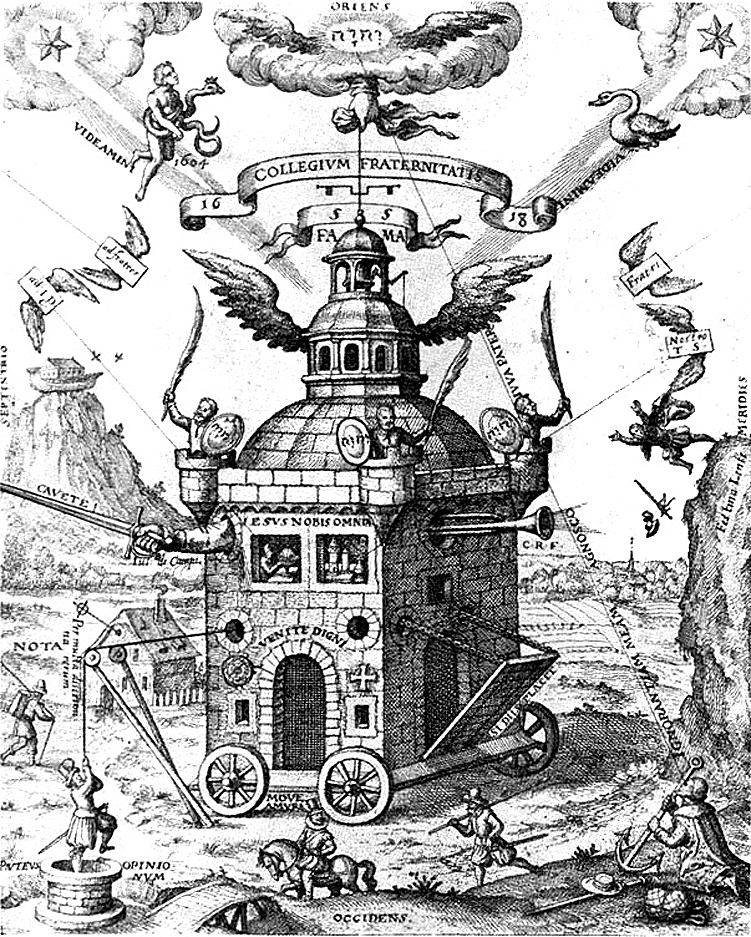
It was always an attempt to address some of the problems I have described above though its practitioners do not have to realize this. I was discussing this last month with the owner of an occult bookstore near West Palm Beach, and I asked him, rhetorically: “what is it about this narrative that can make a pagan Gothic king fall to his knees and convert from only the testimony of missionaries?” One factor would be its awakening the mind to a deep, biological faculty of estimation via symbolic and allegorical resonance, undoubtedly intentional on Jesus’s part. Since this faculty is universally repressed (via the regular, unproportionate investment of libido), its rediscovery is cathartic to varying extents. It would seem the improvement it confers can be quite drastic, though not what I would call divine, and furthermore, it would seem that Jews usually have little interest in it. Were people simpler in the past, and were they once so simple that this switcheroo had real salvific power? But we have since found that the completeness of catharsis is better furthered by following the protocols of orgonomy, whose point-of-departure from the church-like psychoanalytic school was mainly this question if I remember correctly: for what reason, if not an alleged death-instinct, does becoming conscious of the repressed only resolve some neuroses? Briefly, the answer was that there were additional defense mechanisms, part of a complex system of cathexes built over the neurotic’s life, viz. character structure, and that the psychoanalysts had not really resolved a single neurosis. But how could someone who went to, say, Columbia University, think a neurosis is resolved when it’s not? It turns out that, even for a poor person, even for a lowly schizophrenic, whom a member of the expert class should be able to compel simply by willing it, there’s no magic bullet. The more finely a case is tailored to the neurosis as it objectively exists in the patient, rather than in the hasty mind of the analyst, the greater the healing, the deeper the neurotic reconnects with what was lost. With quick fixes, the neurotic will never believe at the most fundamental, visceral level that his or her destroyers were wrong: orgastic potency. That is what I consider Salvation. Analysis, and all medicine, and even religion for that matter, are rackets and shell-games, mere means of attaching oneself to the senile, rotten professional class – no matter what the practitioner has tricked himself into believing – if orgastic potency is not the end-goal so for now, Satan is the god of the world and the inmates are running the asylum. And in case you are one who would rather write off what I say, or try to hide what you did to me, you should know I am thought by mainstream psychiatrists from a huge for-profit hospital corporation to have no mental illness, and more, not that that should matter. But as for the schizophrenics, they are the ones who would lose everything before relegating their betrayers to Hell in their minds.
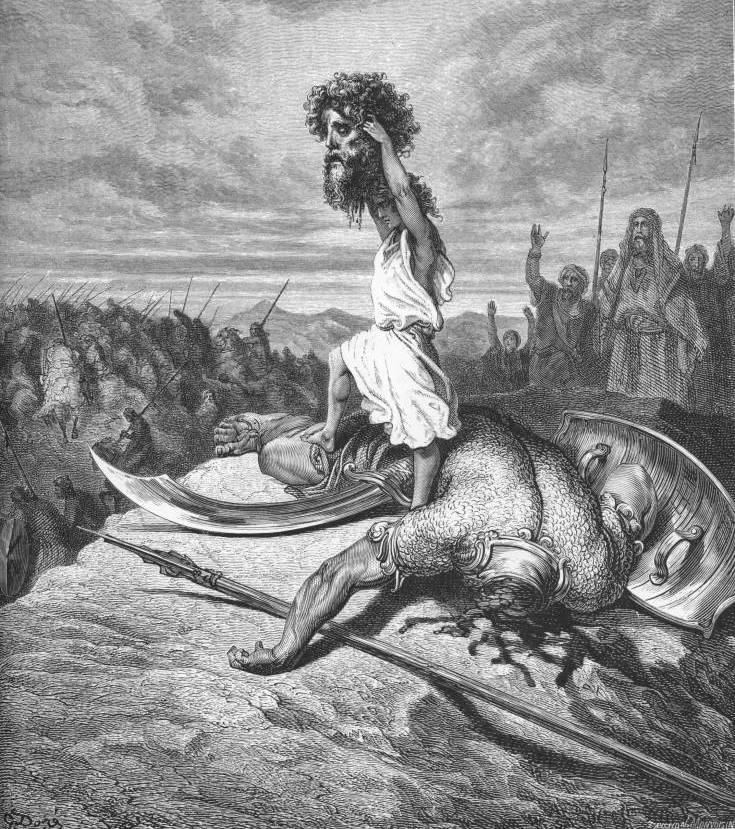
Anyway, Goliath is best killed with a sling and his own sword. Science portends that it is not the magnitude of effort or suffering that effects a certain result, but specific acts which reliably change system structures or quantities. For obvious reasons, this can’t exactly be applied to people, though I have found the non-cardinal quantitative or economic theory of libido to be infinitely useful. It suggests neurosis, which is never organic and always contracted from others, is identical not just to orgastic impotence, but to over-esteeming bigness in general and the magnitude of excitation one has experienced – gigantism, Nephalim if you like. Application of mathematics to the physical begins to loosen this tendency. Yes the acceleration is large, but that’s not so impressive because the mass is small, force constant. Yes the current is large but the resistance is small, voltage constant. Perhaps this pertains to why the Romans associated small penises with intelligence, though I doubt there’s actually a relation. Aspects of armoring also resemble these equations which relate one quantity to the product of two others, so perhaps we can forgive Newton for deviating from Bacon’s unbroken ascent. A cathexis or the whole character structure may essentially have the expression of, “if I stop squandering my energies in diminutive, life-denying expressions, I will re-experience the pain that inspired me to start in the first place.” That is absolutely true, but there is a hidden variable, a caveat, which is that the pain had a cause in the past which is no longer present. This cause, moreover, is an aberration to be abhorred, one which had no right to overwhelm you and should disappear forever. What’s more, we must re-experience the condition to learn that it was not authentic living which caused the pain, but the abuses of the committers of injustice. We must become orgastically potent and want everyone else to be orgastically potent – these things are inseparable. Someone once told me that I can “cast out demons,” and coming from that particular person, it meant the world.
Exactly as there are pathological equilibria of libidinal economy (in which a neurotic is comforted by his detrimental cathexes because he prefers them to the excitation they prevent), these metaphysics, though they prevent social and personal chaos, though they may transform those who adopt them, are imperfect and they leave people behind. But the saddest and stupidest fact about the handling of the alleged Messiah’s legacy is that the universal experience which gives the Gospel its salience is so disregarded by Christians. That must be maddening, like a woman mocking the man who loves her by appearing to him as a bride on Valentine’s Day before going off with another man to be used by him. Maybe if that first man were put on the Cross, her hatred and viciousness would be appeased and dissipate. He could be forgiven for discovering how unwomanly she was. But suffering itself cannot resolve problems, only action informed by the rational discovery of causes.
Throughout history, we have also seen those appeased by Jews being slaughtered, having their property confiscated, being exiled, starved, or by believing that they will be damned. It must be interpreted as admiration from prideful, decrepit people. And consider the deep, biological libidinal dynamic which inspires the rationalization for this madness in general, the accusation that the Jews killed Christ. Well, let me tell you something: the Jews are not capable of killing Christ in this personal way, the way which the height of Christianity’s esotericism concerns itself with, the way which is more important than the Crucifixion which took place at Calvary. Circumcision on the eighth day has prevented this the whole time. The Blood of the Redeemer is on other hands, if any.
I would advise everyone to clean up the ledgers of their lives and make accounts of everything they’ve done. It may hurt at first, but there’s no greater pleasure than to have internal consistency, to take responsibility for the transgressions we have made, to truly disavow our destruction and be able to with perfect sincerity, as opposed to a disguise, affirm the highest degree of human and Godly love, the highest grandeur and splendor for all, to abandon cynicism, sarcasm, jealousy and despair. Then can the Soul, driven out by its own ignorance, return at last to the chemical Body, and the Messiah come at the End of the World, where He has finally to lay His head, as it were. You might arrive at the Wedding just in time.
The non-existence of Jesus is a fringe theory; that has been established. Then there’s the Shroud of Turin, with its enigmatic photographic imprint, a completely unique method of creating an image on fabric, most likely due to some anomalous phenomenon that issued from the Body of the Man it represents, one displaying Stigmata – blood stains and a slight, irreplicable burning of only the most superficial fibers, evidently caused by a burst of radiant energy. But whether the Resurrection took place or not, it does not follow that those who believe in this are saved from sin anymore than it follows that one is because one thinks. In fact, the evidence to the contrary is ubiquitous, and people who believe in this have made my life Hell. I don’t think they’ve ever had to wonder if they made gold or not. I know of a Salvation that does not constantly resist sin, but eradicates it completely – but you think you’re better than me and should go before me. It is a Salvation beyond the metaphysics of Gurnemanz and the lamentations of Amfortas, who languish in the gloomy haze of Monsalvat.
But for now, we shall await the triply crowned Messiah, King by Philosophy, Circumcision, and only then by Davidic Blood, which has been boiling unpretentiously for millennia in obscurity. Meanwhile, His proponents arrange the conditions under which He can emerge from His Occultation.
* * *
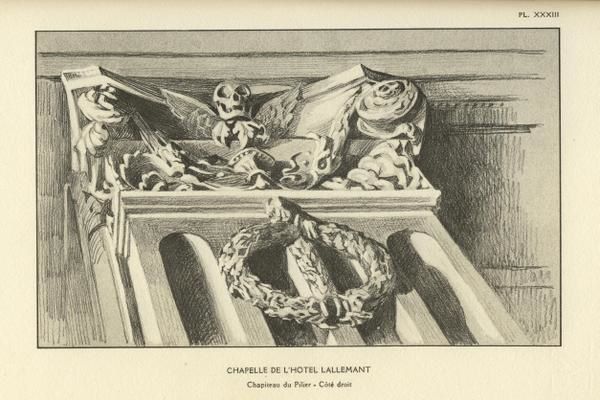
What are we to think of the body of Alchemical literature, saturated with arcana and symbolism, which seems to grow more involved the longer one reads? In the second part of The Mystery of the Cathedrals, the Philosophers’ Stone is the end-goal but by the third, it is demoted to precursor. And what are we to think of the lengthy explication given by Fulcanelli upon seeing the crisscross pattern on St. Christopher’s belt in an Hôtel Lallement bas-relief, or the bizarre letter his initiator received, which Canseliet included in the preface to the Second Edition? And what of the Cyclic Cross at St. Vincent’s in Hendaye, with its enigmatic cryptogram featuring a mistake made on purpose, deciphered via the “rules of diplomacy,” the subject of so much popular speculation – the chapter concerning the End of the World, the Double Cataclysm, with the book’s forty-ninth and final plate, evoking the Jubilee and the Fiftieth Gate of Lurianic Kabbalah, which denied Moses and is only surpassable to the Messiah? What of the “Gospel according to Science, the last of all but for us the first?” What is this practice, thought not to be, at the very least existing as these writings, which seem to veil some technical knowledge, as artisans and manufacturers still do to this day?
For me, the nut began to crack when I contemplated Fulcanelli’s instruction to disregard a saying from The Twelve Keys of Basil Valentine, which he calls an allegation. It can be found in a discussion, which takes an insulting tone, on the credence in Hôtel Lallement displaying the enigmatic text “RERE RER” thrice. The section in which it is found was the end of the First Edition, which, I say for reasons other than verbosity, did not include the famous chapter on the Cyclic Cross, and was published during the interbellum period in a batch of only three hundred copies, while the Second Edition, with its more obvious disclosure of Fulcanelli’s identity, was mass-produced after the war. Anyway, Valentine wrote that “he who has the matter will easily find a pot to cook it in.” Fulcanelli “maintain[s], on the contrary – and you may have faith in [his] sincerity – that it will be impossible to obtain the slightest success in the Work, if you do not know perfectly what this Philosophers’ Vase is, nor from what material it must be made.” Having venerated Valentine, universally considered a Magus, in so many other places, I began to suspect that he did not doubt the statement’s veracity, but thought this advice published in 1599 was no longer applicable in the 1920s, and with the theme of perennialism introduced in the Second Edition, that of cyclic decay, the idea that humanity will have disappeared in some sense before the end of the Yuga, I apprehended what I think might be the secretum secretorum, but not before I, being able to, leveled a terrible accusation against everyone I’ve ever known, and shed the tendency I have born my entire life, to always stoop and put others before me, to never mobilize my powers and seize what I want, to always spare my opponents, so to speak: what world religions teach, knowing it is seldom if at all followed. Insanity is its only reward. I could not see how cowardly, insincere, unserious, vicious and selfish everyone was, especially those I trusted most. I loved them too much. No one could help me. They thought I had too much already. It was they who needed my help and they took it liberally. Is this not the tendency which drives us, like Prospero, into the arms of Hermeticism in the first place? To the Sons of Science and all the World’s Righteous I say: “Blessed is the LORD, who permits the forbidden!” I put my trust in you to do the right thing. For the rest, perhaps the phrase of which the Hendaye cryptogram is a corruption is more worthy of analysis and their endeavors to find in it a secret message, the Mystery of the Apocalypse: O Crux Ave, Spes Unica.
In the preface to the American Edition (in which the plates are conveniently embedded between text pages for the price of Julien Champagne’s original drawings being quietly replaced with photographs!), Roy E. Thompson Jr. makes an interesting but false claim. He states that the Alchemists have always kept their silence about which operation in the Great Work is performed first. Well, according to the very author of the text he prefaces, whose identity Canseliet hid right under our noses with his gesture to Jonathan Swift, writing at the chilling end of Dwellings of the Philosophers, that would be Dissolution, “called death by the old authors.”
* * *
UPDATE (6/1/25): Just as I am accused again of having an impure heart, the Almighty has made another auroid body appear in my work. Once a stripping bath loses its efficiency, I pour it into the caustic water wherewith I neutralize the stripped wares when they come out of the bath. There is still nitric acid so I ‘deNOx,’ as the refiners say, with a saturated solution of sulfamic acid, converting the nitric acid into sulfuric acid and releasing nitrogen oxides. Lately I have been reducing the silver, at this point existing as a cation, with solid copper via Galvanic dislodgement, to wit, cementation; when a nobler metal is in solution and a solid, baser metal is submerged therein, the noble metal will – is supposed to – oxidize and dissolve the base metal, and this while reducing itself and making itself solid, albeit spongy, by seizing electrons from the base metal. This is the quintessential expression of metallic nobility, as determined by every possible tournament pairing of species. When I submerge a bare bright copper wire in the solution, I normally observe silver ‘cementing out’ on the solid, red copper as the blue color of the solution is fortified by the copper ions this introduces. Today I witnessed for the first time hydrogen gas evolving on the copper wire. Evidently, the acidic protons were pairing up and reducing themselves with the copper’s electrons, though this should not be possible for a metal as noble as copper, which ranks above hydrogen, set at zero volts by convention, in reduction potential. I think this could happen if the concentration of hydrogen ion was high enough to gain favorability over silver reduction – perhaps a matter of potential energy, mass action, and entropy – but the solution wasn’t any more acidic than normal. By then it was a comparatively dilute sulfuric acid with a small excess of sulfamic acid, and dissolved metallic cations. More strangely, there was a small amount of metal cementing on the copper during the hydrogen’s evolution but when it stopped being reduced, so did the metal. Also, the temperature fell. Even stranger, I found the solution to be still very pregnant with silver afterwards, as determined by adding muriatic acid to a sample thereof, which resulted in a white cloud of silver chloride appearing like the sperm of some great fish. My experience with electrolysis tells me that for hydrogen ions to oxidize copper … there would have to be a strong electric field driving this non-spontaneous reaction. Anyway, as the solution effervesced with a white foam of hydrogen bubbles, I spotted what looked like a gold leaf, one millimeter in diameter, sailing like a boat on the current the gas was creating in the acid, a beautiful, perfect body navigating this chemical farce! I put a pH paper under it and lifted it out, and saw that it was exactly the color and luster of gold. If it is gold, it’s what prospectors would call ‘fly poop,’ because it is very small, not enough for any kind of qualitative analysis. From now on, I will save any gold-like material I see for more testing, and if it is gold, selling, and eventually, taking care of my future Wife! I won’t be able to help her have spine-flopping orgasms if I’m too fatigued from working all the time.
UPDATE (6/6/25) It’s been a rough week, but the Almighty has consoled me again and reassured me of who has the pure heart. This auroid material appeared after I dissolved the dregs of a stripping bath, which included some silver sulfate, in water and deNOxed with a saturated sulfamic acid solution. It billowed a horrific red cloud of nitrogen dioxide and tried 150° F. Once it was deNOxed, I prepared to cement the silver on copper but saw a two by three millimeter rectangular leaf with the color and luster of gold floating on the surface. I retrieved it with a pH strip, examined it, and fell upon my knees and elbows, crying and thanking God. There were several leaves in this half liter of acid, some floating on the surface, some revealed by decantation. The dregs of this solution contained material resembling solid silver, anomalous in and of itself, as well as a black powder which may also be gold. I will attempt to dissolve it in Aqua Regia on Monday. I tell you, these little flecks are worth more to me than my Wiener Philharmoniker one ounce round!

 sonsofscience.org