Almost two millennia ago, Pontius Pilate reportedly asked Jesus, rhetorically, almost mockingly and completely uninterested in an answer, “what is Truth?” right before going out to tell the Jews he found no fault with Him. To this day, the most exclusive and discriminating of us maintain the question remains unresolved, but whereas Pilate seemed to think Truth is a concern of fools, the naïve, the idealists, we hold it to be desirable and approachable.
‘To be’ is that verb which expresses that a subject and its predicate are the same. When we say something is something, we are equating it with itself (as in the case of God’s Name revealed in Exodus 3, I AM THAT I AM), or with attributes and properties it embodies and actions it is taking or suffering. From the standpoint of the monism which underlies many systems of thought, this may appear to be a fruitless endeavor, for we are merely drawing linkages between parts of the Whole, but the practical reason for holding beliefs, which amounts to making being-statements, has always been to persist as integral systems as we are assailed by all sorts of external forces.
At the most crude level of survival, basic knowledge of needs and threats, and Techne for meeting and mitigating them are necessary. One should not approach a cave lion or sleep in the snow. That being established, higher iterations of being want for survival. The personality, like some exotic bird collecting pretty rocks for its nest, develops all sorts of opinions about itself and its relations to others. When these are challenged, pain and anxiety are felt; humiliation, we say, evoking the Earth, the dirt, as if that’s so bad. Much of human relationship is the mutual masturbation of these illusions, and not challenging them because we want to gain and don’t want our own illusions challenged. Such affronts, we feel, do not reflect the Truth, but the bad quality of their issuer as we are overwhelmed by bad feelings. There are those of us, however, who would surmise that the magnitude of the pain experienced suggests our own wrongness, that these disappointments really only awaken us to an internal threat, a contradiction threatening the construction we have fabricated. Either way, these events spell death for that part of the illusion or for our esteeming that friend or lover, just as being wrong about the cave lion results in death. Now something must die. Maybe our friend was right and they reproached in us what caused our misery and inhibited our life – or maybe they are an enemy of Life and Truth, a player of the High Stakes Game for whom there will be Divine Justice.
Often such a betrayal or perceived betrayal inspires us to embark on a deeper investigation into Truth. We wade into a sea of gurus, philosophers, institutions, prophets, psychologists, mentors and practices, all laying claim to orthodoxy. Which one is right, considering that it’s all a matter of semantics and personal preference? Clearly, whichever imparts Eternal Life, if we are to go by the original spirit of belief: survival. We can have Eternal Life for our delusions by condemning every challenger and excluding them from our lives. We can have Eternal Life for our Soul, which is so ethereal and unoffensive it is already immortal. But the most complete knowledge of the internal and external, the ultimate way of living, should impart Eternal Life and Eternal Youth to the body, the possibility of which most people reject prima facie, as if they are rich enough to forgo such a treasure. They say things like “I wouldn’t want to live forever.” I believe that we should acknowledge and even honor the organism’s original desire without fear of being disappointed in this domain. Is our fear of death not already death itself, and who can ask us to die again?
Anyway, having discerned that this humiliation augmented, counterintuitively, our vigor, we wonder what other errors we have made in understanding ourselves. Surrendering the libidinally charged ideas adopted in youth, these unnecessary wastes of effort, and entertaining the experiences and emotions these investments repressed, the question “what is Truth,” insofar as it pertains to ourselves, becomes very interesting. We find that each time we adopted an inauthentic defense it was a death for our True Self. Each time we surrender one it is a death for our false self and a Resurrection for our True Self, as our bodies become enlivened with surging energies withdrawn from these malign hang-ups. This further confirms our suspicion that death is continuous as opposed to discrete, a mathematician might say. Like Reich, we find that all these psychological cathexes corresponded to – no, were identical to – chronic muscle contractions and habits of shallow breathing and the violent interruption of our sexual excitement, &c., and as the Cross was transformed from an instrument of torture into one of Salvation, our musculoskeletal tomb becomes the ultimate diagnostic tool, a complete map of the Enemy’s positions. It becomes a womb out of which we are born again. Then, upon a profitable resolution of the Oedipus Complex and its chronic strangulation of the pelvic musculature, signified by the attainment of orgastic potency, the capacity to permit a spine-flopping orgasm reflex – it’s just a capacity – we have fully accepted the fate of maturation. At the same time we may intuit that our identity is contradictions all the way down, to our very core, like Lucifer, second to God but surpassing God without being God – or the Son of God who is not the Father, but is also God, who “lived and died and lives evermore” (Revelation 1:18), “firstborn from the grave” (Revelation 1:5), the “Bright Morning Star” (Revelation 22:16) which heralds the dawn after the long night of history. This is Remora, the Philosophic Fish (or icthys) spoken of by Fulcanelli, taking the Piscean shape of a biconvex lens, of which there is only one in the entire ocean, who, when isolated and fully dehydrated by the Artist, imparts the ability to “control the accuracy and veracity of philosophical claims.” That, I suppose, is why the Magus advises us, in his alchemical interpretation of the Adam and Eve story (cf. Dwellings of the Philosophers), to leave this Fish a little water.
But even this is not the sum of Truth, which we defined as that which, when believed, imparts Eternal Youth and Eternal Life to the body, and to embody this condition, every force working against it must be sufficiently neutralized. We must be impervious to arms, or never have them raised against us. We must be impervious to the elements or be sufficiently sheltered from them. Under no circumstance should we test whether or not we have Eternal Life, in case we don’t. Knowing it is immaterial to having it. At this point it becomes apparent that the next thing we should pursue is a nuanced understanding of health and any force noxious to it, internal or external, or better still, that which is common to them all.
There is a natural tendency to employ metaphysics to this end. In New Chemical Light, Michael Sendivogius (the Cosmopolite) related this faculty to the First Matter, the quasi-vile, quasi-invaluable substance on which the operations of the Great Work are performed, by calling it merely the Mirror of the Art, in which “anyone … can see and learn the three parts of the Wisdom of the whole world and in this way … become very wise in these three kingdoms, as were Aristotle, Avicenna and many others.” Through this Mirror we can apprehend that earth, water, and air cannot be decomposed into simpler elements, that the brain’s primary function is to radiate heat, that the Messiah has already come, and that no man can surpass Mohammad (peace be upon him) in virtue, but Hermeticism implies the Mirror of the Art must undergo many operations to fulfil the promises of the Philosophers’ Stone. Our very way of thinking did not completely survive the Fall of Man, and we should always keep this in mind until the problem is resolved.
The epistemology we laid out above suggests that the conclusions we make about phenomena curtail our expansion and enjoyment. It is some combination of perception and belief that elicits our general, biophysical no-saying to life. Therefore, we should undertake investigations of nature in order to determine if obstacles to our continuing are either internal and therefore dissolvable by reason and Art, or external, requiring technology and praxis. However, it is most likely not a mechanistic understanding of the microcosm as a causal substratum that will be our Salvation – no, not our subordination to the Tyranny of the Very Small, but rather the dual action of the following principles.
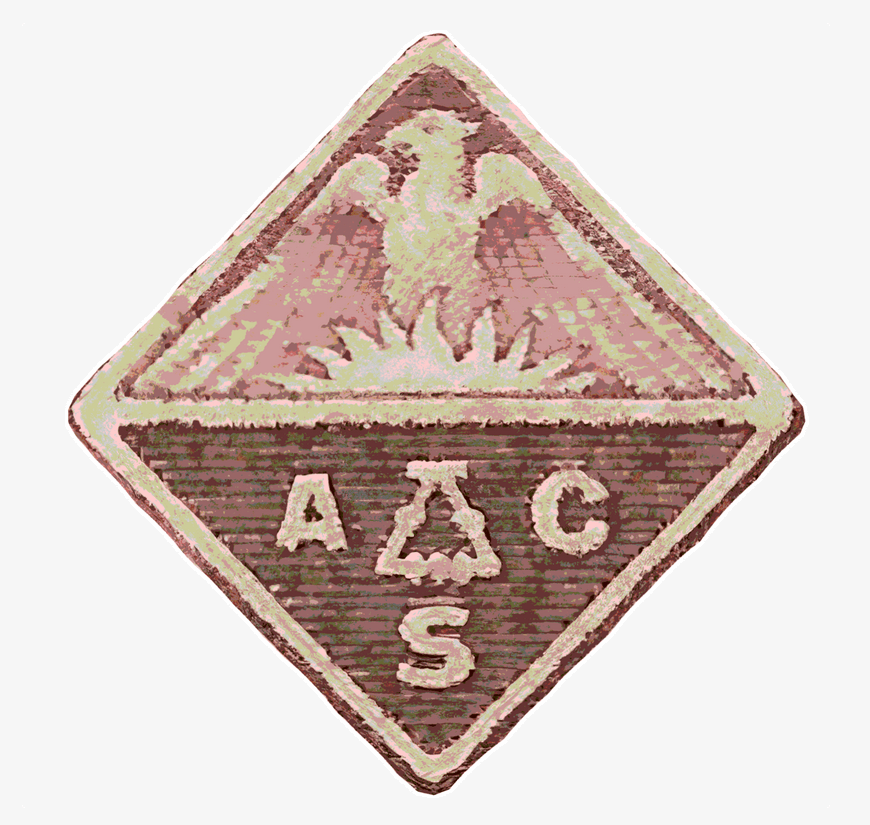
The first is the salutary suffering that comes from bothering to understand something beyond what we already feel we know. As we pour into the world during such sustained attention, the Secret Fire calcines the old body. This idea is elegantly expressed in the old logo of the American Chemical Society, designed by Tiffany & Co. in 1908, a diamond-shaped frame divided into two halves by a horizontal solid bar: below, a kaliapparat for weighing a product of combustion – above, a Phoenix rising from flames. I encourage everyone to acquire a simple retort and attempt the distillation of brandy from wine. Buy a furnace and crucible to melt and cast some aluminum cans.
The second is the inner alignment one experiences upon apprehending faithfully the common function of all phenomena, the volatilization and fixation of the same fluid, our Mercury. It is this reagent, ultimately, which governs the separateness and togetherness of bodies and substances. It imparts vileness to those which stubbornly persist in ignorance while despising fate, and nobility to those whose enterprises are dynamism and evolution. Thus it unites in being the disparate, often warring parts to accomplish a greater end. For Man’s case, it would bestow proportion to those seemingly insoluble complexes arising from the quasi-survival of the ancient brain, to wit, the undeadness of the ancient brain, the antithesis thereof being its absolute death and pristine original condition: the First and the Last.
Across this gulf, this Flood, the Shining Kingdom of the Messiah has been established, where justness and honesty and uprightness are as compelling as obscurity and flattery are down here. Its subjects are as sweet as they were before their hearts were broken for the first time. For those who will be swept away, however, the humiliation will be too great to bear when they are brought low before that priceless treasure against which they’ve erected their entire beings. That, my friends, is the Good News: in the immortal words of Fulcanelli, “the Gospel according to Science, the last of all, but for us the first, because it teaches us that save for a small number of the élite, we must all perish,” and “… Science, which alone is capable of penetrating the mystery of things, of beings and their destiny, can give man wings to raise him to knowledge of the highest truths and finally to God.”
* * *
This was read at the symposium Science, Scientism & Mythology on Sunday December 21st, 2025 in Lexington, Kentucky.

 sonsofscience.org