Formal logics can lay flat but proceed from axioms, given assumptions. Informal logic and metaphysics are plagued by ambiguities and internal contradictions. Whereas the former deal with pure mathematics, the latter purport to touch the world through language, losing supernal consistency and clarity. They don’t even gain independence from axiom reliance through this sacrifice. Physics and the sciences which depend on it attempt to bridge the gap by designating physical quantities and trying to find their mathematical relations. Common to all these enterprises is the imposition of logics onto the unknown to the end of understanding the field of experience.
The most obvious reason for pursuing understanding is, for starters, it can help us continue to live with an acceptable level of happiness and meaning. This goal, along with universal wealth, was what Sir Francis Bacon hoped his method of inductive reasoning would bring about, but it has not yet been achieved. If anything, our condition is only worsening, though the Hog is not to blame. Business-as-usual and the tyranny of syllogism through Algebra are not what he had in mind. As I wrote elsewhere, it was always a reaction to Christian metaphysics, whose self-soothing, circular reasoning neglects the more fundamental causes of human misery, which we ultimately locate in the personal libidinal economy. It is the same criticism that Wagner would present in his last music drama, the same story over and over, with St. Paul and Aristotle, the know-it-alls, as Gurnemanz and Amfortas, and Bacon himself as the Pure Fool.
Why is Christianity insufficient? It would be better to ask why it is sufficient. We all know we must take a “leap of faith” because there is no evidence. What they don’t tell you is that there’s a preponderance of evidence (the whole world) against the claim that Jesus of Nazareth was the Messiah, though He is certainly Messiah-like, typologically. Hear, O Israel! Not only this, He states that believers will accomplish greater works than His (John 14:12), but where are these works? Maybe we must drink the Kool-Aid, get the ocular mutilation, to even understand. A wise Catholic monk once told me, “the point of Christianity is to become God” – but it’s very easy to forget this. We are as crabs in a bucket, and if anyone gets too Godly, we first feel they should flatter us, and if they don’t, we tear them down. The Messiah is supposed to put an end to this, and, having an answer for everything without investigation, Christianity can recourse to the Second Coming. So now, not only do we have eyes not to see and ears not to hear; we have a Messiah not to usher in the World to Come, let alone impart anything I would consider Salvation. The Heavenly City is quickly absconding from our Lake of Fire and we do not notice the temperature rising so long as our secret Godhood is not affronted.
If there is any salutary effect of Christian ideation, it is because it promotes the dissolution of chronic libido investments. It does so by attempting to affirm more fundamental, unconditioned modes of being (and it has been shown how inferior it is to orgonomy in this regard). Our conception of God is informed by our fathers, hence God the Father, the inexorable power that records itself on our potentiality, binding it in libido investments. Through patrilineal descent, adaptations, which are the chronic exchanges of potentiality for condition, to wit, the crystallizations of potential (mercury) into the actual (sulphur), may be transmitted. The surface onto which they are recorded, however, is not a “blank slate,” but the common, conserved structure of the human brain and body, into which embryos develop if enveloped in the womb environment. Thus after every generation there is a resistive, synaptic gap so to speak, which retards and countervails the signal of inheritance and dilutes the sum of traumatic recording with the unconditioned, the chance to forget. This is what has come to be known as “the Son.” It is at least as legitimate as the cathexes sepulchering it, though in practice this claim is extremely controversial, even among us good-Christian-folk trying to become God. God is like the father times infinity, else there would be no Son left over to conceive of a greater God.
Complimenting Man becoming God, we have the idea of God becoming Man as Jesus, repeated ad nauseam. It is one of those things that can be understood with increasing degrees of completeness, from the hypocritical bleating of the flock, to the various researches, to the Messianic Work itself. Divine proportion, logic, must be conjured down to the personal libidinal economy, not just to every other subject matter imaginable. The metabolism of motivational energy, viz., character structure, requires this rectification above all other fields, and it is almost as if the others receive it at the former’s expense. The infidelities of sciences and philosophies, their contradictions and dead ends, are most likely due to the sickness of their practitioners, which handicaps the discovery of patterns and veils the avenues of fruitful inquiry; as Nietzsche said, they produce cathartic confessions of personal dissonance masquerading as theories and descriptions of phenomena – senile, resentful, orgastically impotent idiots pharisizing themselves because they can’t regulate their œconomies, going through the motions, writing crap that no one will read and babysitting the children of boomers who believe in college, a recipe for sexual abuse. On the contrary, the Sons of Science can envision miraculous new forms of Work and a new “Science of Man.” Thus I call upon all clerics, theologians, natural philosophers, geometers, urban planners and architects, masons, statesmen, physicians, metaphysicians, and scientists – all we who are Godly and made of Fire and Heaven: thus begins our untergangen!
* * *
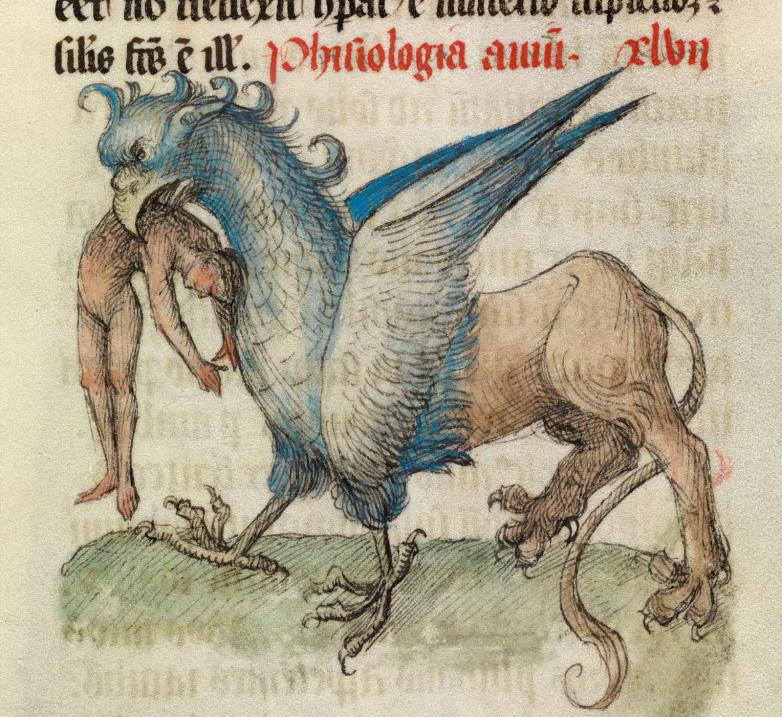
Griffin, 1460, from Liber Floridus compiled by Lambert, canon of Saint Omer. Parchment. Leaf: 40.8 × 28.6 cm (16 1/16 × 11 1/4 in.). The Hague, Koninklijke Bibliotheek, National Library of the Netherlands
 sonsofscience.org