In order to avoid ridiculous excesses in our researches, we must continually return to the Human. Cause is primarily experienced through the excitation it effects, at least when an effect is the cause of a perception. For instance, a ball thrown from right to left is represented by a wave – like people doing the wave in a stadium – of excitation propagating from left to right on the television-screen-like, albeit folded, primary visual cortex, which is located across the brain from the eyes. The left halves of the retinas project to the left side of the visual cortex while the right halves of the retinas project to the right side, wherefore the fibers from the contralateral eyes, like many other facets of the nervous system – and the light rays refracting in the ocular lens – must cross. However, we must delay our discussion of causality because it is in epistemology, complimented by science, which we locate our Supreme Axiom, the hidden root or trunk, or Stone, of Philosophy from which the branches of metaphysics, ontology, ethics, and aesthetics grow in their infinite bifurcation, like four rivers flowing out of Eden, from the Tree of Knowledge. Before looking at them, we must know how we know.
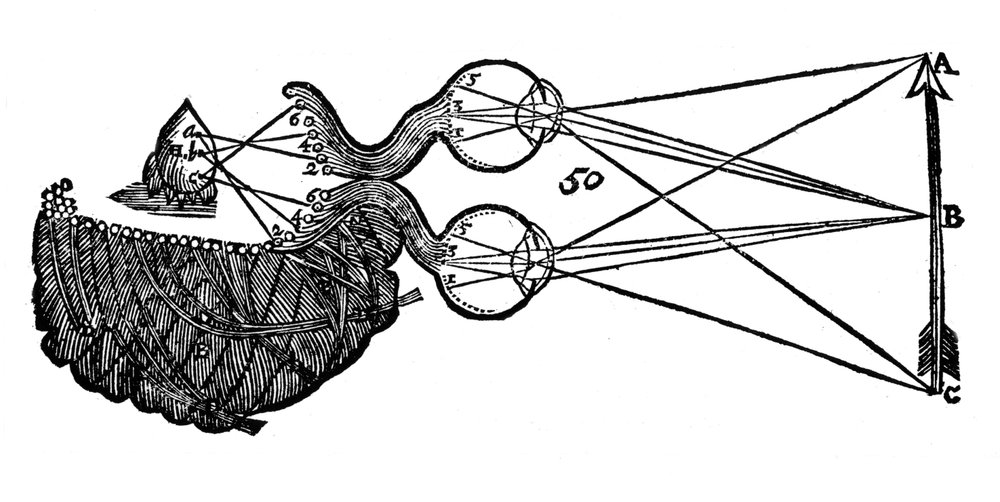
While accounting for image inversion due to lens refraction, Descartes wrongly charged the pineal gland with the task of representing images and assumed the brain must correct the inversion internally with another inversion. He believed the optic chiasm (from the Greek Chi, Cross) integrated perceptions from the eyes, resulting in a unified field of vision. Ironically enough, Descartes loved cross-eyed women above all others but could not apprehend that we are all inwardly cross-eyed.
How, then, do we apprehend statements, facts, and Truth, with our brain, the organ whose complexity seems so tied up with rational thought? It is accomplished through cathexis and catharsis, like everything else. Agents, grammatical subjects of sentences, alarm the organism by being perceived, and the denouement of this excitement is brought about by reacting. In the State of Nature perhaps, you hear a rustling, “that,” and the catharsis is achieved by concluding it “is a squirrel,” the predicate. If it is worse than a squirrel, more reaction may be necessary to achieve catharsis. We can to some extent console ourselves and resolve or mute the tension that comes from experience by naming, categorizing, and forming ideas about causes. This function, however, is just a finely tuned, extended version of the more primal reaction faculties, which conscript anything at hand, and depend on reflex arcs and ultimately the discharge of potential energy.
Now let us endeavor to differentiate between belief and knowledge. All knowledge is belief (and true) but not all belief is knowledge. But “quid est veritas?” To answer Pilate’s question is to declare our Supreme Axiom: Truth is that which, when believed, imparts Eternal Life and Eternal Youth to the Body. This is a stunning idea so let us approach it with apophasis and ask, “what is falsehood?” It is that which may be believed but is not true. But first, “what is belief?”
More so than any linguistic utterance or inscription, our reactions, acute and chronic, and ultimately the very forms of our bodies should be referred to as our beliefs. Reaction is communion with stimuli, which exert real Newtonian forces on sensory cells, triggering cascades of internal signaling events. We involuntarily believe in these stimuli whether we like it or not. There is not even a real boundary of identity in these interactions of cosmic parts, and any endeavor to construct one could be considered an admission of being overwhelmed! That being said, forces can hinder our wills so we neutralize them through various defensive actions, such as using technology. Reacting to these forces, either by undergoing their obliterating effects (such as being mauled by a cave lion) or attempting to mitigate them (brandishing a torch in its face: Cro Magnon examples), are both functionally identical, as the orgonomists would say wielding Reich’s paraconsistent logic orgonomic functionalism, to belief in these forces and their cause. And I remind you that something as gentle as the light reflecting off an object can induce belief in a qualitatively identical way, to wit, vision. In other words, “seeing is believing.”
We continue to ask “what is falsehood,” in our comparison of knowledge and belief. Now if one thing influences another, they are united in being, as it is with organisms in an ecosystem. That being said, there are gradations of hostility and friendliness, gradations of differentness and togetherness between them, where the following relations may be listed from most hostile to least: predator and prey, individuals of the same species, two mates, mother and child, mother and fetus, two organs in an individual, &c. We can even extrapolate this to regions of tissue in an organ – such as the brain. And while the various nuclei and pathways of the brain are united, their conflict or interplay as separate parts likely is the basis for – or at least represents – adaptation, belief, religion, reason, science, and everything human for that matter. In what is apparently a complex network with mysterious function, certain structures and pathways can be discerned, more or less common to us all. There is some relationship between reification and elderliness, undifferentiatedness and youth. Some structures are conserved across animal phyla and orders. Some can be unique to an individual, like a dense region in Albert Einstein’s right motor cortex thought to be related to his violin fingering. They project axons to each other and into the peripheral nervous system, and receive projections from the sensory nervous system. Their management and integration of sense excitations, determination of reaction, and governance of physiological toni, which are all the same function, together express the most forthright picture of the organism’s conception of its being and surroundings: its beliefs.
Now, the friendliness between an organism’s parts is a measure of its coherence, its capability, its health, its joy objectively, its knowledge, and so on. I know how to be very nice to my parts! Conversely, if the parts are hostile and endeavor to maintain separateness, the organism is chaotic, incapacitated, sickly and miserable. The brain however, having not one isolated nucleus or neuron, is torn between its unity as an organ and its duty to integrate perceptions faithfully, torn between its unity and its environment, including the rest of the body and possibly even parts of itself. Unitedness is easier to maintain when there is a tolerable frequency of excitation events, but during great arousal, the organism is inclined to put an end to the escalation. It does so by managing the if-then contingencies or causes of arousal, and by making sacrifices and repressing drives so the excitement mercifully relents. It says, “What? No I’m not the King of the Jews! This is all a big misunderstanding. Can I go now, please, Mr. Governor, sir?”
However, as I stated above something must be sacrificed, be it the organism’s present condition or a more substantial form of integrity. That is a Law of Nature concerning interaction in general. What’s more, it is the particularity of what is sacrificed in these instances which determines the truth-value of our beliefs because, depending on the reaction made, the cohesion of the organism can either wax or wane; the whole can grow more vigorous or more sickly, or even die. Therefore, it must react proportionally, at once showcasing both the extent of its understanding and that its reaction minimally disturbs its organismic cohesion and joy. Ignorance, denying the natures of experienced phenomena, is synonymous with disproportionately reacting to them, which disequilibrates the brain-body and libidinal economy either by our own doing (overreaction), or by virtue of our being harmed by the phenomenon (underreaction), or some combination of both. The fact that this disequilibration can vary in severity means that knowledge and falsehood are not two opposites, but exist on a gradient, and the criterion determining where belief falls on this gradient is whether or not it is a reaction which quickly and rationally restores libido-economic equilibrium. If knowledge is true belief, and Truth is that which, when believed, imparts Eternal Life and Eternal Youth to the Body, then as our beliefs approach knowledge, health vigor and artistry increase because the disturbances from the phenomena one is knowing are optimally managed. Here we have a fine example of an orgonomic “antithetical functional identity;” though falsehood and knowledge are antithetical, they are functionally identical in that they are both forms of libidinal metabolism, only differing in quality.
Now, finally, let us compare the beliefs of the organism, total bodily expression, with linguistic belief statements people make. These utterances are a facet of one’s total body expression, certainly not separate from it. Words are vain and easy to loose upon the world, meaning little without their context or knowing who their author is. That, I suppose, is why it’s customary for the Hermeticists to use pseudonyms. Human physical beauty, however, is an expression of something infinitely greater: divine proportion in being that approaches knowledge of immortal Truth. Words fade as soon as they are spoken and lose elsewhere if recorded. Their meanings erode as they are used in decreasingly logical arguments and grammatical oversights, exactly, exactly as the cohesion and health of the organism weaken when its reactions are infidelitous to reality. They and their careless speakers are marred by exaggeration, lies, perjury, rhetorical devices. We grow numb to them. They irritate us.
Sorcerers employ words and symbols; they are nothing to them. Across the lever, those who hear them are animated; their œconomies churn like the witch’s cauldron! What was in them that these talismanic sayings released? These macabre dancers … they are made of words, and verily, my Son, he who lives by the word dies by the word.
By its very nature, language cannot express belief because, for one thing, beliefs are incalculably complex arrangements of material and energy with dimension in time: structuralism vs. desiring-production. What, then, is the utility of describing them, of modeling the body and recreating it, if it already exists and expresses itself better than we ever could? It is because, somehow, we, our persons, have been separated from our bodies by some barrier, intrabodily hostility, and no longer know what they are saying. Therefore, we do not know what we believe. Therefore, we do not know what’s out there, outside our little hierarchy of signifiers – or what’s within. Therefore, we live a lie. Therefore, we are dying. We say we believe with our lips, but our hearts are far.

